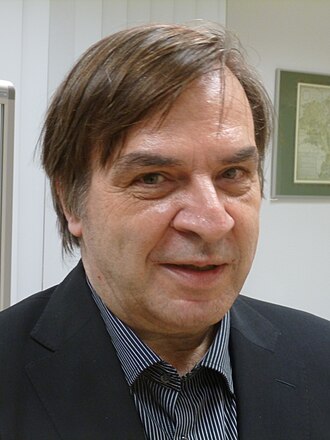
Hitler's Role in the Persuection of the Jews by the Nazi Regime: Electronic Version
by Heinz Peter Longerich · edition 2003
A CURRICULUM VITAE
(i)For the last twenty years my academic work has been concentrated on the Nazi Dicatorship, its structure, its origins and ist legacy. My work in this field which consists in particular of a dozen monographs and editions is highly regarded both in Germany and internationally.
(ii)I can declare my self an expert in working with archival documents, mostly unpublished, from this period. During the last twenty years I have workd in about 40 archives in Germany, Britian, Israel, Lithuania, the Soviet Union and the United States.
(iii)From the very beginning of my academic research I have been particularly interested in the structure of the Nazi system and the decision making-process. This interest developed when I wrote my dissertation, a study about bureaucratic infighting and decision-making in the Nazi Propaganda machinery. After completion of my dissertation I worked for several years at the Institut für Zeitgeschichte in Munich. During a period of more than five years at the Institute I edited the Second Part of the Project Akten der Partei-Kanzlei, an attempt to reconstruct the lost original files from the Nazi Party Chancellery, the central office of the Nazi party which coordinated the organisation of the Party and controlled the state bureacracy. This work which envolved the reading and summing up of about 80.000 pages of documents from the Nazi period gave me a unique insight into the day to day history of the Nazi system and a subtle understanding for the bureaucratic language and the behaviour of officials in this system. During my stay at the Institute I wrote two other books, a history of the Nazi Stormtroopers and a organisation history of the Party chancellery.
(iv)Since the end of the eighties my interest concentrated more and more on what I see today as the central chapter of the Nazi period: The persecution and murder of European Jews. I started this work by editing a collection of documents about the Holocaust in 1989. When I edited the book I war particularly concerned with the authenticity of the material and therefore consulted the great majority of the dorcuments as originals in archives.
(v)The publication of the German version of the Encyclopedia of the Holocaust (together with Eberhard Jäcke and Julius H. Schoeps) a work which included an updating of many of the articles, provided me with an excellent overview about research in this field
(vi)An invitiation to spent ten month at the International Center for Holocaust Research at Yad Vashem, Jerusalem, gave me the opportunity to lay the cornerstone for a major monograph of the Holocaust, a book which was issued in 1998 (in German) under the title policy of annihilation and containes a comprehensive history of the persecution of the Jews in the period between 1933 and 1945. The manuscript of this book was accepted as Habilitationsschrift by the University of the Armed Forces in Munich in early 1999. (The Habilitation is the highest qualification at a German University and the basic condition for the award of a professorship). During the last two years I had the opportunity to give papers about the main results of this research at numerous Universities, Research Centres and Museums in Germany, Britain, the United States and Israel.
(vii)I have never stopped to attemped to look at the Holocaust and the Nazi period in a broader historical perspecitive; the last book before the book on the Holocaust was a comprehensive history of the Weimar Republic and at the moment I am working on a comparative study about manpower mobilisation in Germany and Great Britain during the Second World War.
Peter Longerich: Born 4 February 1955, Krefeld, Germany: German Citizen
- 1961-65St. Franciscus Schule (Primary School), Krefeld, Germany
- 1965-73Kaiser-Karl-Gymnasium, Itzehoe, Germany
- 1973Abitur
- 1973-74University of Göttingen: History, Sociology, Public Law
- 1974-75National Service
- 1975-76Studies at University of Göttingen: History, Sociology, Public Law
- 1976-80Studies at University of Munich: History, Sociology
- 1980Magister Artium
- 1983Dr. Phil, University of Munich (Thesis title: Die Presseabteilung des Auswärtigen Amtes unter Ribbentrop. Supervisor: Professor Gerhard A. Ritter).
- 1999Habilitation, University of the Armed Forces, Munich
- 1990Research grant from the German Historical Institute, London
- 1992-93Research grant from the Deutsche Forschungsgemeinschaft
- 1995-96Research grant from Yad Vashem, the Israeli Research Center for the Holocaust, Jerusalem, to enable me to work there for 10 months.
- 1976-1979 Department of History, University of Munich: Research Assistant to Dr. Klaus Tenfelde and Professor Gerhard A. Ritter. Project: Bibliographie zur Geschichte der deutschen Arbeiterschaft und Arbeiterbewegung (published: Braunschweig, Bonn: Institut für Sozialgeschichte, 1981)
- 1983-8 Institut für Zeitgeschichte, Munich: Research worker and (from 1985) responsible for the project: Rekonstruktion der Akten der Partei-Kanzlei der NSDAP, Teil II
- 1987-89 Department of History, University of Munich: Part-time undergraduate teaching: German and European history.
- 1993-96 Lecturer, Department of German, Royal Holloway, University of London
- 1996 to date Department of German, Royal Holloway, University of London
- 1991-92 Consultant historian to the Crown Office War Crimes Investigation Team, Edinburgh. I advised the Crown Office on the basis of documentation which I collected from archives in Germany, Israel, Lithuania and the Soviet Union
- Consultancies for Second German Television, Piper Publisher (Munich), Pendo Publisher (Munich)
- Member of the Editorial Advisory Board of The Journal of Holocaust Education.
- Monographs
- Propagandisten im Krieg. Die Presseabteilung des Auswärtigen Amtes unter Ribbentrop, (Munich: Oldenburg, 1987, Studien zur Zeitgeschichte, Vol. 33) 356pp
- Die braunen Bataillone. Geschichte der SA (Munich: C.H. Beck 1989) 285pp
- Hitlers Stellvertreter. Führung der NSDAP und Kontrolle des Staatsapparates durch den Stab Heß und Bormanns Partei-Kanzlei (Munich: Saur, 1992) 283pp
- Deutschland 1918-1933. Die Weimarer Republik Handbuch zur Geschichte, (Hannover: Fackelträger, 1995) 425pp
- Die Wannsee-Konferenz vom 20. Januar 1942: Planung und Beginn des Genozids an den europäischen Juden (Berlin: Edition Hentrich) 90pp
- Politik der Vernichtung. Eine Gesamtdarstellung der nationalsozialistischen Judenverfolgung (Munich: Piper 1998) 772pp Editing of Documents
- Akten der Partei-Kanzlei, Teil II Rekonstruktion eines verlorengegangenen Bestandes, 3 Vols. (Munich: Piper, 1992)
- Die Ermordung der europäischen Juden. Eine umfassende Dokumentation des Holocaust (Munich: Piper, 1989, 2 editions) 480pp
- Was ist des Deutschen Vaterland? Dokumente zur Frage der deutschen Einheit, (Munich: Piper, 1990, 4th edition 1996)
- Die zweite Republik. Dokumente zur Geschichte des Weimarer Staates, (Munich: Piper, 1992) Editions
- Enzyklopädie des Holocaust. German edition (3 Vols.) with Eberhard Jäckel and Julius Schoeps (Berlin: Argon, 1993) [German version of the Hebrew and English editions published by Yad Vashem] Articles and Chapters
- Joseph Goebbels und der totale Krieg. Eine unbekannte Denkschrift des Propagandaministers, in: Vierteljahreshefte für Zeitgeschichte 35 (1987), 289-314 [Reprinted in the series Zum Nachdenken, 1988]
- Vom Massenmord zur "Endlösung". Die Erschie8ungen von jhdischen Zivilisten in den ersten Monaten des Ostfeldzuges im Kontext des nationalsozialistischen Judenmordes, in: Zwei Wege nach Moskau. Vom Hitler-Stalin-Pakt bis zum "Unternehmen Barbarossa", edited by Bernd Wegner, (Munich: Piper, 1991) 251-274. English translation: From Mass Murder to "Final Solution": The Shooting of Jewish Civilians during the First Month of the Eastern Campaign within the Context of Nazi-Jewish Genocide, in From Peace to War. Germany, Soviet Russia and the World, 1939-41, edited by Bernd Wegner (Providence and Oxford: Berghahn Books, 1997), 253-276.
- Der Rußlandkrieg als rassistischer Vernichtungskrieg, in Der Mensch gegen den Menschen. überlegungen und Forschungen zum deutschen überfall auf die Sowjetunion 1941, edited by Hans-Heinrich Nolte (Hanover: Fackelträger, 1992), 78-94.
- Nationalsozialistische Propaganda, in: Deutschland 1933-1945, edited by Karl Dietrich Bracher, Manfred Funke and Hans-Adolf Jacobsen (Munich: Piper, 1993), 291-314.
- Vom Straßenkampf zum Anstaltsterror. Die Oranienburger SA und "ihr" Konzentrationslager, in: Konzentrationslager Oranienburg, edited by Günter Morsch, (Berlin: Hentrich, 1994), 23-33.
- Der Untergang der Weimarer Republik und die Machtüernahme der Nationalsozialisten, in: Der neue alte Rechtsradikalismus, edited by Ulrich Wank (Munich: Piper, 1993), 65-94
- In addition I have 23 entries in Enzyklopädie der Holocaust, German edition (Berlin: Argon 1993)
- I have reviewed several books in academic journals and newspapers. Papers and Broadcasts
- 1991 30-minute radio programme on total war for the Westdeutsche Rundfunk, Cologne. Broadcast in January 1991.
- 1991 to date Numerous radio broadcasts on aspects of Nazi history arising from my publications.
- 1991 (June) University of Hannover: International symposium to mark the 50th anniversary or the German attack on the Soviet Union: Paper: "German Racist Warfare in the East".
- 1992 (May) University of Munich: Paper on German documents in Soviet archives.
- 1993 (March) History Society, Bad Nauheim: Paper on German Nationalism.
- 1993 (July) University of Munich: public lecture on the rise of the Nazi Party.
- 1994 (April) Oldenburg: participated in a public, recorded discussion with Professor Israel Gutman (Yad Vashem) and Professor Eberhard Jäckel (University of Stuttgart) on the occasion of the awarding of the Ossietzky Prize for the publication of the Encylopaedia of the Holocaust, in which I collaborated for the German edition.
- 1994 (July) Wiener Library, London: Paper on the Bomb plot of 20 July 1945.
- 1994 (Nov) University of St Andrews, Department of History: Paper on the commemoration of historical events in post-war West Germany.
- 1995 (Sept) Wiener Library, London: Paper on the Nürnberg Laws.
- 1996 (Jan) Hebrew University, Jerusalem: Paper: "The German Dictatorship and the Persecution of Jews"
- 1997 Papers on my book Politik der Vernichtung at the (June/July) following universities: Cologne, Berlin, Freiburg, Stuttgart.
- 1998 (Jan) Annual lecture: Haus der Wannseekonferenz, Berlin.
- 1998 (Jan) Talk on the Wannseekonferenz, Imperial War Museum, London.
- 1998 (April) University of Florida: paper on decision-making and the Holocaust.
- 1998 (Nov) 45 minutes TV discussion of my book Politik der Vernichtung, in the programme, Lesezeichen, 3SAT, German Public Television
- 1998 (Nov) Lecture, German Historical Institute, London on Politik der Vernichtung
- 1998 (Dec) Paper on the genesis of the "Final Solution", International Conference, Tel Aviv University
- 1999 (Jan)Paper on Himmler and the Holocaust, Symposium, Forschungsstelle für Zeitgeschichte, Hamburg
- 1999 (March)Paper in a German-Israeli round table discussion on the state of Holocaust research
- 1999 (April)Lecture tour, organised by the US Holocaust Memorial Museum (Washington, Los Angeles, Chicago, Clark University)
- 1999 (May)Paper on my book Politik der Vernichtung, Gonville and Caius College, Cambridge
HITLER`S ROLE IN THE PERSECUTION OF THE JEWS BY THE NAZI REGIME
There can be no doubt that Hitler's behaviour during his entire political career - from the end of the First World War until the end of the Second World War - was characterised by radical antisemitism. Hitler`s actions betray a desire to - in one way or another - put an end to the existence of Jews within the "living space" (Lebensraum) of the German people. This objective carried a very high priority in his political practice.
Of course Hitler's antisemitic stance cannot by itself explain the persecution and murder of the European Jews by the Nazi regime; a history of the "final solution" must nevertheless take account of his central role in the decision making process.
1. General remarks about Hitler`s Antisemitic terminology
1.1An account of Hitler's role in the genesis of the final solution is complicated by the fact that the dictator avoided the use of explicit written directives relating to the murder of the Jews. When he came to speak on this subject he used expressions which, to say the least, leave a certain amount of room for interpretation. The meaning of the key words describing the aims of Nazi anti-Jewish policy changed over the years when antisemitic policy became more and more radicalized. There is no meaning to these terms independent of the time factor. To translate these terms properly, one has to take the reality of antisemitic policy into account. When the same vocabulary was used to describe Nazi aims towards other groups, the meaning might have been be completely different. As far as the fate of the Jews is concerned, formulations such as annihilation (Vernichtung), extirpation (Ausrottung), final solution (Endlösung) removal (Entfernung), resettlement (Umsiedlung), evacuation (Evakuierung) etc. were used by Hitler and leading National Socialists from mid 1941 onwards increasingly - and from Spring 1942 definitely - as camouflage for mass murder.
1.2Before this time, the very same vocabulary was used by Hitler and leading Nazis in a different sense. As will be described in more detail in this report, an interpretation has to take into account the different stages of anti-Jewish policy. During the 1920's and up to the mid 1930's, the main aim of Nazi anti-Jewish policy was to undermine the legal and economic situation of the German Jews so as to force them to emigrate. The Jews would disappear from the vantage point of the Nazis from German public life and later on, from German territory. When the Nazis used the term annihilation (Vernichtung) during these early years, they referred on the one hand to the planned destruction of the alleged dominant position of the Jewish minority in German society. From the context of the relevant texts, however, it is obvious, on the other hand, that this term had a vaguely defined violent and even murderous component, by which Hitler and the Nazis signified their main goal - which was the "removal of the Jews". In a cautious interpretation of this terminology, it would not be exaggerated to describe the meaning of annihilation here as ambiguous. The perspective of mass murder was already present here. In conclusion, one has to say, that during this period (the 1920's end the first half of the 1930's), the Nazis saw in the "final solution" a potentially violent "removal" of Jews from German public live and German soil.
1.3At the end of the 1930's, the Nazis intensified the pressure for emigration or expulsion. During this period, terms like "removal" (Entfernung) or "final solution" (Endlösung) revealed an inconsistency with the notion of a further existence of a Jewish minority in Germany. The violent aspect of anti-Jewish policy became more and more significant. In the last year before the outbreak of the Second World War the term extermination pointed clearly to the possiblility of genocide.
1.4Between the outbreak of war in Summer 1939 and the middle of 1941, the Nazis were looking for a so called "territorial solution" of the Jewish problem, i.e. they were planning to deport the Jews to a territory on the periphery of their empire where there were insufficient means to subsist and where they would perish. Technically the terms resettlement (Umsiedlung) or evacuation (Evakuierung) meant a kind of geographical relocation but one cannot disregard the fact that this vocabulary increasingly offered the perspective of the physical end of the Jews in Europe. The term "final solution" was used in this period in the same way.
1.5Between the summer of 1941 and the spring of 1942 the meaning of this vocabulary changed. It was now increasingly used as a synonym for systematic mass murder. However, even in this period - particularly between Autumn of 1941 and Spring 1942 - this terminology can in some cases still be ambivalent. For an interpretation each phrase has to be analysed in its historical context. In particular, in a period in which one Jewish minority after another was being included in the process of systematic mass murder, one has to determine which Jewish minority was indicated by each of the relevant phrases.
1.6One cannot exclude the possibility that, for example, up to May or even June 1942, i.e. during the has when preparations for the systematic murder of European Jews were well underway, Hitler and the leading organisers of the murderous programme might have occasionally mentioned "alternative" murderous programmes for a "final solution"; they might, even at this stage, have referred to the earlier plan to deport Jews (particularly those from Western Europe, who before the summer of 1942 had not been included in the programme of systematic mass murder) to other areas than occupied Poland and to kill them or let them perish. These "alternative" considerations should be interpreted as a kind of reluctance by Hitler and members of the leading circle of Nazis, fully to articulate the consequences of the decision to kill millions of people, a decision which in fact had already been made and implemented at this point.
2. HITLER`S EARLY UTTERANCES ON THE "JEWISH QUESTION"
2.1Hitler's very first political statement, his letter to Adolf Gemlich on 16 September 1919, already includes a clear declaration of his antisemitic position (Gemlich was a former participant in one of the political indoctrination courses organised by the military authorities in Bavaria, on which Hitler had taught) . “Antisemitism of the emotional sort finds its final expression in the form of pogroms. Rational antisemitism on the other hand, must lead to a systematic legal opposition and elimination of those special privileges which the Jews hold, in contrast to the other aliens living among us (alien's legislation). Its final objective must unswervingly be the removal of the Jews altogether.”
2.2This outlook also characterises Hitler's early public posture. The radicalism of his antisemitic statements at this point is remarkable; clearly his vision of a "removal" of the German Jews carried definite implications of violence. As early as 1920 he spoke of extirpation (Ausrottung) and annihilation (Vernichtung). Thus according to a police report of a NSDAP meeting on 6 April 1920 he declared: “We have no intention of being emotional antisemites who want to create the atmosphere of a pogrom; instead, our hearts are filled with an inexorable determination to attack the evil at its roots and to extirpate it root and branch. In order to reach our goal every means will be justified, even if we have to make a pact with the devil.”
2.3In a talk before a gathering of National Socialists in Salzburg on 7 August 1920 he said: “Don't think that one can fight against disease without killing the cause, without exterminating the germ; and don't think that one can fight against racial tuberculosis without taking care that the peoples be freed of the germ of racial tuberculosis. The effect of Judaism will never disappear and the poisoning of the people will not end unless the cause - the Jews - are removed from our presence. ”
2.4In the first large mass meeting of the NSDAP after the refounding of the Party (which had been banned after the failed putsch of 1923) Hitler, on 27 February 1925, looked back on the founding of the NSDAP and explained: “The goal then was clear and simple: fight against the devilish power which has pushed Germany into this misery, fight against Marxism as well as the spiritual carrier of this world plague and epidemic - the Jews. Fight - not on the bourgeois model 'carefully' so that it doesn't hurt. No and once again no.”
2.5In another part of this speech Hitler spoke about the newly founded Party: "Who does this movement have to combat? Against the Jew as an individual and Marxism as his cause.
2.6And in another passage, Hitler pointed once again to the chief objective of the National Socialists - to the struggle against the Jewish "poison" within the German people (Volk), in his view clearly a lethal danger: “The greatest danger is and remains for us the poison of foreign peoples in our body. All other dangers are limited in time. Only this alone is eternally present in its consequences for us. [...] The peace treaty can be abrogated, reparation obligations can be declared invalid and rejected, political parties can be disposed of, but blood that is once poisoned can never be altered. It remains and proliferates and pushes us down from year to year ever deeper. If you are surprised today about the inner turmoil of our people than consider the following: The blood which is at odds with itself is merely expressing itself in the inner turmoil of the German people. And there lies the greatest danger, that with the continuation of this poisoning in 10, 20 and 30 years we will be weaker than now, in 100 years weaker than after 30 and in 200 years more unconsciousness than after 100 years; one day however the time will come when our people will fall from its cultural heights and will finally hopelessly perish as a result of this blood poisoning... ”
2.7In his book, MEIN KAMPF, which appeared in 1926 and especially in a manuscript written in 1927, which remained unpublished until after 1945 (his "Second Book"), Hitler placed this radical view, which leads to the "removal" of the Jews from Germany, within the context of a theory which he tried to derive historically. According to this theory, the meaning of world history is a permanent struggle between the races or the peoples (Völker) over "living space" (Lebensraum). In this model the Jews, who are said to be unable to develop their own territorial state or culture, play the role of parasitic beings who seek to destroy from within (together with other Jews in a international conspiracy) the construction of Lebensraum empires by the superior races.
2.8This "theory" is described most clearly in a lengthy section in his "second book": “The Jewish people, because of their own lack of productive capacity, are not able to build up their own territorial state. Rather, they need the work and creative activity of other nations as a base for their own existence. The existence of the Jews themselves thus becomes that of a parasite within the life of other peoples. The final goal of the Jewish struggle for survival is therefore the enslavement of productive peoples. To reach this goal, which in truth describes the struggle for existence of Jewry in all times, the Jew uses all weapons which correspond to the whole complex of his being. Domestically, he fights within the individual nations first for equality and then for superiority. As weapons he uses cunning, cleverness, subterfuge, malice, dissimulation, etc..., qualities which are rooted in the essence of his ethnic character. They are ruses in his struggle for existence, similar to the ruses other peoples use in sword-fights. In terms of foreign policy, he tries to make the peoples restless, distracting them from their true interests, pushing them into wars with one another and in this way, with the help of the power of money and propaganda to bring them under his dominance. His ultimate goal is the denationalisation, the promiscuous bastardisation of other peoples - the lowering of the racial niveau of the highest peoples as well as domination over his racial porridge through the extirpation of the völkisch intelligencia and its replacement by members of his own people. The end of the Jewish world struggle will thus always be bloody Bolshevisation, that means in truth the destruction of the spiritual elite which is bound with the peoples, so that he alone can ascend and become master of a mankind which has been rendered leaderless. Stupidity, cowardice and wickedness help him to achieve his goals. In the bastard he secures himself the first opening so as to break into the body of another people. The end of Jewish domination is nevertheless always the decay of all culture and finally the insanity of the Jew himself. Then he becomes a parasite of the peoples and his victory signifies the death of his victim as well as his own end.”
2.9As is clearly demonstrated in his MEIN KAMPF and his "Second Book", Hitler perceived the situation of Germany after the end of the first World War to be the consequence of an international Jewish conspiracy. Jews dominated "international finance capital" as well as the socialist movement: they were responsible for war, revolutions, the decline of national values and for the pernicious "mixing of the races".
2.10The language which Hitler used in this early period to refer to the Jews was filled with boundless hatred. Eberhard Jäckel once compiled a series of typical designations for Jews from MEIN KAMPF: The Jew is a maggot in a rotting corpse; a germ carrier of the worst sort; mankind's eternal germ of disunion; the spider that slowly sucks the people's blood out of its pores; the pack of rats fighting bloodily among themselves; the parasites in the body of other peoples; a sponger, who, like a harmful bacillus, continues to spread; the eternal bloodsucker; the peoples' parasite; the vampire.
2.11An analysis of the public statements by Hitler in the second half of the twentieth century shows clearly that antisemitism had always played a central role in his thinking. In Hitler's speeches in this period, antisemitism was by no means a marginal element used only for demagogic purposes. Rather, antisemitism was the central component of the ideological structure which he endeavored - with stubborn perseverence - to convey to his listerners.
2.12For even when Hitler concerned himself with political questions of the day, in the course of his public statements in the second half of the twenties, the large majority of his speeches and articles would usually return to the ideological train of thought which he had developed in MEIN KAMPF and in his second book. These ideological considerations were necessary for him so as to explain the precarious situation in which Germany found itself after the end of the first World War.
2.13Central categories in Hitler's public statements continued to be "space" and "race": the future of the Germans as a racially valuable people depended upon the conquest of as great a space as possible. The fulfilment of this historical mission, which according to Hitler's central argument was decisive for the security of the existence of the German people, was obstructed by systematic attempts by the "Jewish race" to prevent it.
2.14Over and over again Hitler repeated in his speeches his stereotypical grievances against the Jews: That they were not able to work productively and were unfit to create culture; that they lacked a positive attitude towards the soil; that instead they had others work for them and charged them interest. He therefore called the Jews "parasites" or "spongers" (Schmarotzer).
2.15In Hitler`s view, through clever activities they had gathered the economy in their hands. Although personally unable to create culture, they had been able to dominate the culture industry and the press and therefore controlled public opinion. The political parties were, in his view, dominated by the Jews. This was especially true for the Socialist parties. In a typical expression, he called "Marxism" the "greatest instrument for the annihilation of the Aryan peoples, for the annihilation of the intelligence of these Aryan peoples and for the constitution of a thin Jewish upper class". In the Soviet Union, this goal had already been largely achieved through Stalin`s dictatorship, in his view.
2.16On an international level, the Jews had also achieved a dominating position in the economy; he claimed that "international finance Jewry" used their position to put additional economic and political pressure upon Germany. Communism and capitalism were, in Hitler's view, both instruments in the hands of Jews for the attainment of a position of world domination: "Western democracy on the one hand and Russian Bolshevism on the other are the forms in which the present Jewish world conspiracy takes its form." The international order created by the Versailles treaty serves the Jews for the purpose of annihilating the German people.
2.17In Hitler's view, the Jews had thus largely succeeded in infiltrating the German people and manipulating and splitting it. The Jews were responsible for the fact that the German people had already begun to turn away from their task which was decisive for their future - that of accumulating soil and working it. The inner division of Germany, the political conflict between the bourgeoisie and the workers was also the work of the Jews. In his speeches, Hitler frequently used the metaphor of a "body of the people" (Volkskörper) which a foreign element had penetrated, in order to describe the supposed dominant position of the Jews within the German "Volk": a cancer - which had to be removed.
2.18From this chain of reasoning, Hitler came to the conclusion that Germany's problems could basically only be solved by means of the removal of the dominance of the Jews. Concretely, he developed specific suggestions which were entirely based upon the Party Programme of the NSDAP: this involved the elimination of the economic ascendancy of the Jews and - in the event that they did not submit - their physical removal: "If he conducts himself well than he can stay, if not than out." Hitler also prepared his listeners for the concept that this settlement of accounts with the Jewish mortal enemy would not be an easy task, but rather might involve a difficult and if necessary violent confrontation.
2.19If one considers the function of antisemitism within Hitler`s world view it becomes clear that it played the role of the central binding element in a hodgepodge of highly contradictory ideas. Hitler's public statements in the second half of the 1920`s make it clear that his world-view (Weltanschauung) was unthinkable without his antisemitism. He promised his listeners that with the solution to the "Jewish problem" he could solve Germany's basic dilemmas in the areas of foreign and domestic policy, as well as in the economic, social and cultural realms.
2.20After 1930, when the NSDAP had become a party with a mass base, the antisemitic element began to recede markedly. Clearly Hitler was aware of the fact that the number of his electors had surpassed the number of radical antisemites in the German population. A more precise analysis of his speeches reveals however that he had not in any way altered his basic ideology. For in fact in the years 1930 to 1933, as the NSDAP attained unprecedented electoral sucess, the basic elements of the Hitler ideology, "space" and "race", remained the center of his speeches. Hitler emphasized on different occasions that he continued to regard the "Jewish race" as the main enemy of the German people.
2.21Thus on 29 August 1930, a few days before the greatest electoral victory of the Nazis in the Reichstag election, in a speech in Munich he announced, in regard to the Jews: "The head of another race sits upon the body of our people (Volkskörper); the heart and the head of our people are no longer one and the same." In another speech a few weeks later, he portrayed the struggle against the Jews (without naming them) as a contract with divinity: “When we present ourselves as German and try to protect ourselves from poisoning by another people, then we are trying to return into the hands of the almighty Creator the very same creature which he bestowed on us...”
3. HITLER AND THE BEGINNING OF AN ANTI-JEWISH POLICY IN 1933
3.1From the very beginning, Hitler, as head of the National Socialist government, pursued a consistently antisemitic policy. Above all, he aspired to remove German Jews from public positions and to segregate them as much as possible from the German population. The decisive role which Hitler played in the enforcement of the Nazi government's anti-Jewish policy is apparent in the organisation of the "boycott" of Jewish businesses on 1 April 1933. Although it was Goebbels, Propaganda Chief of the Party and newly appointed Minister of Propaganda, who organised the embargo on Jewish establishments, the decisive initiative was Hitler's. This was confirmed by Goebbels in his diary entry of 26 March 1933: according to this account Hitler called him to Berchtesgaden in order to inform him of his "resolution" according to which one could “only deal with the slanderous attacks from abroad if we lay hold of the originators or at least those who stand to profit from them- namely the Jews who live in Germany and who have remained unmolested.”
3.2Moreover, Hitler took over the full responsibility for the call for a boycott committee consisting of leading NSDAP officials when he made it clear in the Ministerial Conference of 28 March 1933 "that he, the Chancellor of the Reich himself had arranged for the proclamation issued by the National Socialist party". On 6 April 1933, Hitler once again explicitly acknowledged his antisemitic policy when on the occasion of a reception of leading medical officials he declared that “through the coming eradication of Jewish intellectuals from the cultural and spiritual life of Germany, Germany's natural title to spiritual leadership, which is characteristic for it, must be done justice.33”
3.3Immediately after the boycott, still in April 1933, the Hitler regime passed three antisemitic laws: Jews were largely excluded from public office and the bar respectively and a quota for Jewish pupils and students was introduced. On the other hand, a series of utterances by Hitler from the first months of the "Third Reich" seem to give the impression, on first glance, that he might have been exercising a rather more moderate influence on the "Jewish policy" of the government and had turned against the more radical elements of the Party.
3.4Thus a pronouncement by Hitler which was issued on 10 March 1933 opposed the "individual actions" (Einzelaktionen) of party activists which might disturb the functioning of Jewish and other businesses. Further, a planned campaign against the Federal Court of Leipzig by the local Party organisation was stopped by a personal directive by Hitler. In the cabinet deliberation on the law concerning lawyers on 7 April, Hitler opposed further plans for exclusion and took the position that one should "at the moment ... only regulate that which is necessary"; legal discrimination against Jewish doctors - an official proposal of this kind had been submitted to the cabinet - was considered "not necessary for the moment".
3.5Hitler's attitude of apparent restraint stemmed wholly from tactical considerations. Hitler wanted to avoid unnecessary quarrels with his conservative coalition partners; he didn't want to put new stress on the already difficult economic situation or to cement the "Third Reich's" isolation in foreign affairs. In his address to the recently appointed Reich Governors on 6 July 1933, Hitler explicitly articulated his foreign policy concerns: "To reopen the Jewish question means to agitate the whole world once again".
3.6In fact, with the take-over of power in 1933, Hitler intended - over and above the assorted antisemitic laws - deliberately to create a special legal status for German Jews: to place them under "alien status" as had been projected in the NSDAP Party Programme of 1920, and gradually to diminish their position in German society. His earlier and considerably more far-reaching plans in the area of racial laws and the reasons why these plans had been deferred were clearly elucidated in the report of his speech to the Reich Governors` Conference, held on 28 September 1933: “As concerns the Jewish question, we were not able to give way. For him, the Chancellor, it would have been preferable if we could have aggravated the treatment of the Jews step by step - beginning with a citizenship law and from that point on becoming gradually more and more severe with them. The boycott instigated by the Jews however obliged us to resort immediately to harsh counter measures. Abroad they complain mainly about the legal treatment of the Jew as a second-class citizens. They argue that the most we can do is to refuse citizenship to Jews who present a danger to the State.”
4. HITLER`S ROLE IN THE EMERGENCE OF THE NUREMBERG LAWS
4.1A period of relative calm in the development of National Socialist policy concerning the Jews can be identified in the period beginning in the second half of 1933 and extending through 1934. During this period the regime tried to avoid a further radicalisation of the persecution of the Jews, because it would have deepen its foreign political isolation, worsen the unstable economic situation, inspire the radicalism of the SA (which the Party tried to bring under control in this period), and annoy their conservative coalition partners who were still in a relatively quiet mood. This situation changed in 1935, after the Nazis had their first success in foreign policy by winning the Saarland referendum, after the Nazi Party had eleminated the leadership of the SA and conservative opponents during the "night of the long knives" (30 June 1934) and secured their dominant power position, and when the economic situation became better.
4.2Starting in 1935 however, Party activists once again triggered antisemitic excesses in the whole empire; these became more numerous and more extreme in the Spring and Summer of 1935. Party activists repeatedly blocked Jewish businesses, perpetrated acts of terror against so-called "racial defilers", organised demonstrations, and prevented marriages between Jews and non-Jews and assaulted Jewish citizens. By means of these abuses, the more radical antisemitic forces in the Party wanted to push through three objectives: 1) the introduction of a special citizenship for Jews 2) prohibitions against marriage as well as sexual relations between Jews and non-Jews and 3) economically discriminatory measures against the Jewish minority.
4.3In August, statements were issued in Hitler's name not only by Rudolf Hess, Hitler's deputy in Party matters, but also by Minister of the Interior Frick, forbidding further "individual actions" (Einzelaktionen). Once again, Hitler's sole concern was tactical - to subdue anti-Jewish abuses which were causing unrest and indignation in the population. In essence, however, he shared the same goals as the party activists.
4.4This clarifies Hitler's role in the genesis of the Nuremberg laws whereby, in particular, marriage and sexual relations between Jews and non-Jews were forbidden and a special, inferior citizenship was defined for Jews. Hitler played a decisive role in the implementation of both of these basic early antisemitic demands of the Nazi Party. He preferred "rational antisemitism" instead of pogroms, as he had stated in 1920.
4.5The decision to include an anti-Jewish law which contained the long-demanded prohibition against "racial defilement" (Rassenschande) in the Reichstag session during the Nuremberg party meeting was made on the evening of 13 September 1935 by a small circle of leading Nazis who had been gathered to meet with Hitler in a Nuremberg hotel.
4.6The official in charge of the Jewish question (Judenreferent) in the Ministry of the Interior, Lösener, has described very vividly in a memoir written after the war how he was unexpectedly called to Nuremberg late in the evening of 13 September in order to help formulate these new laws. On the next day, according to Lösener's report, together with a group of officials from the ministry, he worked out numerous drafts for the law which was later called the Law for the Protection of German Blood (Blutschutzgesetz). Minister of the Interior Frick presented them to Hitler and then brought them back with specific proposals for amendment. On Saturday, 14 September, around midnight, Hitler demanded that four alternative drafts be submitted for the Blutschutzgesetz by the following morning. Further, according to Lösener's account, Hitler now asked the officials to prepare another law, namely a blueprint of a "basic law, a citizenship law" for the next day. On the following day Hitler decided for one of the drafts of the protection of German blood law and had it passed in the Reichstag, together with the Reich citizenship law (Reichsbürgergesetz) which had also been drafted overnight.
4.7After laws were passed, Hitler declared at the Nuremberg Party Conference that the law for the protection of German blood was "the attempt legally to regulate a problem by which in the event of repeated failure would definitely be transferred to the National Socialist Party by law in order to achieve a final solution". He thereby made clear that he was prepared to use street terror by Party activists (which he had earlier condemned in public declarations) as an instrument for enforcing his policies.
5. HITLER AND THE ANTISEMITIC LEGISLATION OF 1936-1937
5.1For the following years, it can be documented that Hitler personally directed anti-Jewish policy and regularly intervened in anti-Jewish legislation. The measures in question were mainly concerned with excluding the Jewish minority from the economy.
5.2In the summer of 1936, Hitler charged Göring with preparations for the Four-Year-Plan (Vierjahresplan), by which the German economy was to be adapted for war. The memorandum which Hitler transmitted to Göring on this subject makes clear that preparation for war and further radicalisation of anti-Jewish policy were closely associated in Hitler's thinking. Hitler's position in this matter was that a war against a supposed Bolshevik-Jewish menace was unavoidable: “Since the outbreak of the French Revolution, the world has been moving ever faster towards a new confrontation. The most extreme solution to this conflict is called Bolshevism and its content and goals are the liquidation (Beseitigung) and replacement (Ersetzung) of the hitherto leading social stratum of mankind by international Jewry.”
5.3In the memorandum, Hitler also explained that preparations for the coming war against "international Jewry" should in part be financed through expropriation of Jewish property. To this purpose he demanded two new anti-Jewish laws: the first, a law "which makes all Jews answerable for the damages which are inflicted upon the German economy and the German people by individual specimens of this criminality"; further, he called for the death penalty for what he called "economic sabotage", (Wirtschaftssabotage) meaning the accumulation of currency reserves abroad. This demand - as further developments would show - was particularly directed against Jewish "economic sabotage": It was satisfied by the law dealing with economic sabotage, promulgated in December 1936, which in fact called for lengthy prison terms or the death penalty for the illegal transfer of property abroad; in the following period it was primarily applied against Jews.
5.4In order to put through the other law which Hitler had proposed in his memorandum on the Four-Year-Plan - the comprehensive accountability of German Jews - a draft of a "law concerning the compensation of damages incurred by the Jews to the German Reich" was prepared at the beginning of February 1937. After this draft was rejected, because of the anticipated negative implications for the economy, Hitler in April 1938 renewed his proposals for a special tax on Jews which could be raised "for the specific situation - behaviour by individual Jews detrimental to the Volk". A proposal of this kind was issued by the responsible departments of the government but was once again rejected by Göring. Only after the November pogrom was the project realised and an "atonement payment" (Sühneleistung) of billions charged to German Jews.
5.5But on the other hand, in the Spring and early Summer of 1937, Hitler decided not to follow through on two important antisemitic legislative projects for the moment. One was the third decree of the law of citizenship (Reichsbürgergesetz) by which among other things, a special trade symbol (Gewerbezeichen) was to be introduced for non-Jewish businesses; as Frick told Göring in February 1937, this proposal was to be enacted according to Hitler's specific order. Nevertheless, the project was once again not treated - and this at Hitler's explicit behest - since the incorporation of holdings by foreign Jews would create complications; it would not be enacted until one year later. Similarly, due to Hitler's specific orders, the project to enact a special document on citizenship (Reichsbürgerbrief) into law was not further pursued.
5.6To conclude this section, one can say that Hitler continued to be intensely preoccupied with anti-Jewish policy in the years 1936-37 and was once again prepared to be flexible for tactical reasons in pressing his goals, as is apparent in the different treatment accorded to the diverse laws - in particular, in this time period, to the further economic discrimination against Jews. However, as the following paragraphs will show, he has not given up his basic aim: to remove the Jews from Germany.
6. HITLER AND THE RADICALISATION OF THE PERSECUTION OF THE JEWS AFTER THE END OF 1937
6.1By the end of 1937, concurrent with the transition to an expansionist foreign policy, a new, more radical phase in the persecution of the Jews began. Priority was given to the goal of expelling the Jews from Germany; this was to be accomplished especially through further discrimination, use of direct violence and greater economic pressure.
6.2This more radical course was actually launched by the strongly antisemitic address given by Hitler at the Reich Party Congress in 1937. In this speech, he turned against, among other things, what he called - in what was typical for his antisemitic vocabulary - "Jewish-Bolshevist subversion" (jüdisch-bolschewistische Zersetzung); the causative organism of the "disease" (Krankheit) Bolshevism was "that international parasite of the Volk which for many centuries has spread in the world, reaching once again full destructive magnitude in our time".
6.3On 30 November 1937 Goebbels recorded the following in his diary about a conversation with Hitler which had taken place the previous day: “Talked about the Jewish question for a long time... The Jews must disappear from Germany, yes out of all of Europe. That will take some time still, but it will happen and must happen. The Führer is firmly committed to this...” At the beginning of 1938 the Office for Foreign Affairs (Aussenpolitische Amt) of the NSDAP informed the German Foreign Office that Hitler had clearly declared himself in favour of Jewish emigration to Palestine.
6.4In order to accelerate the expulsion of the Jews from Germany, a Reich-wide move to arrest Jews having a criminal record (even an insignificant one) began as early as the summer of 1938. Hitler frequently intervened directly in these "actions". He personally gave the order to include Jews in a general action against "asocials" as is clear from a note by the Director of the Jewish department of the SD (Security Service, Sicherheitsdienst) of the Nazi Party) of 8 June 1938. “In a discussion on 1 June 1938, with C (=Heydrich, P.L), it was confidentially pointed out that - on the orders of the Führer - asocial and criminal Jews should be arrested and used for the purpose of earth-moving work .”
6.5There also exists evidence that Hitler concerned himself with the details of the propaganda which accompanied the mass arrests. When in the course of the campaign against "asocials" and Jews Goebbels asserted in a speech that more than 3000 Jews had moved to Berlin - he did this for the purpose of stirring up antisemitic feelings - Heydrich complained to the Ministry of Propaganda about this inaccuracy. He then learned that Goebbels had used the incorrect figures "with the permission of the Führer".
6.6Nonetheless, the arrests in the Reich capital degenerated: Goebbels`s ruthlessly kindled anti-Jewish excesses turned to riots by the Party base and threatened to endanger public order and led to critical reports in the foreign press. The excesses were put to an end "upon the Führer's order", as noted in a draft of a report of the Jewish Department of the Sicherheitsdienst.
6.7On 24 August 1938, in a talk with Hitler, Goebbels once again confirmed that despite the break-up of the campaign he had Hitler's basic agreement for a further radicalisation of the persecution. “We discuss the Jewish question. The Führer approves my procedures in Berlin. What the foreign press writes is insignificant. The main thing is that the Jews be pushed out. In 10 years they must be removed from Germany. But in the interim we still want to keep the Jews here as pawns.”
6.8The last sentence already points to the fact that Hitler, in view of increased international tensions, was beginning to think of taking the German Jews as hostages. The German Jews would serve as pawns.
7. HITLER AND THE POGROM OF 9 NOVEMBER
7.1The course of the November pogrom of 1938 also clearly demonstrates Hitler`s personal initiative. It is inconceivable that Hitler was taken by surprise during the party meeting commemorating the 9th of November, 1923 by the news of the death of the German diplomat vom Rath - the event which the Nazis used as an excuse for launching the pogrom. Rath died in the late afternoon (17.30 German time); Hitler had expressly sent his personal physician Brandt to Paris "for consultation and for direct reportage", according to the Völkische Beobachter. He must therefore have already been informed at first hand in the afternoon, before the party meeting had begun, along with Goebbels, Gauleiter (i.e. one of the regional chiefs of the Nazi Party) Jordan and the Foreign Office.
7.2Before Goebbels held his speech that evening, in which he incited the assembled party leadership to the pogrom, he had already received clear instructions from Hitler, as he noted in his diary: "I am going to the party reception in the old City Hall. Huge crowd. I explain the matter to the Führer. He decides: allow the demonstrations to continue, Pull back the police. The Jews shall for once come to feel the anger of the people. That is correct".
7.3Eyewitness reports according to which Hitler seemed surprised and annoyed about the pogrom in the late evening, if they are credible at all, can only be related to the extent of the damages in Munich and elsewhere, not however to the fact that the party had organised an anti-Jewish "action" that night. The concept of an unsuspecting Hitler is misleading if only because already on 7 November, the day of Rath's assassination, party activists had provoked violent anti-Jewish excesses in different parts of the Reich which were heralded by the Nazi press as a spontaneous reaction showing the anger of the German population.
8. HITLER ORDERS THE MEASURES FOLLOWING THE POGROM
8.1After the pogrom, Göring was entrusted by Hitler with the direction and control of further "anti-Jewish policies"; while Hitler conferred upon Göring the task of investigating all decrees relating to the "Jewish question" before publication, in fact Hitler himself settled the details of further "anti-Jewish policies" in the months following the pogrom.
8.2Thus Göring disclosed a series of concrete decisions by Hitler in a conference with leading representatives of the Reich and the Party on 6 December. According to these resolutions, there was to be no particular label for Jews; no prohibition against selling to Jews; a boycott against Jews (Judenbann) could be ordered for certain localities.
8.3On 28 December 1938, after a discussion with Hitler, Göring communicated to central party and state officials the "authoritative expression of the will of the Führer" (Willensmeinung des Führers) on further measures to be taken against Jews. Accordingly, the law for the protection of tenants was not, in general, to be abrogated for Jews. On the other hand, in "individual cases" it was declared to be desirable to "proceed in such a way that Jews be quartered together in separate houses in so far as the contract situation allow". The use of sleeping and dining cars was to be forbidden for Jews. The use of "certain public establishments" (gewisse, der öffentlichkeit zugängliche Eirichtungen), such as bath houses or health baths, could be prohibited to Jews. Jews who were civil servants were not to be denied their pensions, but the possibility of reducing payments was to be investigated. Jewish welfare organisations were to be allowed to continue to exist. Jewish patents were to be "aryanised". Further, Hitler gave specific orders concerning living accommodations for people in "mixed marriages" and the "aryanisation" of their property. This catalogue is an excellent example of how precisely Hitler's detailed instructions were transmitted by Göring and translated into reality by the bureaucracy.
8.4Thus the Reich Transport Minister (Reichsverkehrminister) forbade Jews the use of sleeping and dining cars on 23 February, following Hitler's "will". By means of the law on rentals to Jews of 30 April 1939, the law for the protection of tenants was extensively curtailed thereby creating a legal situation according to Hitler's orders whereby Jews could be quartered together in separate houses. The law, once again based on Hitler's "will", however, ordered that German-Jewish mixed families with children be allowed to remain in their homes. With the circular put out by the Minister of the Interior on June 1939 Hitler's wish regarding the "Judenbann" was fulfilled whereby the presence of Jews in baths and health establishments could be curtailed.
8.5As early as 12 November, at the meeting of leading representatives of the Party and State which was held under Göring's direction and which dealt with further measures of anti-Jewish policy, Göring announced that Hitler would “now finally make a foreign policy thrust, beginning with the powers who had raised the Jewish question, in order really to arrive at a solution to the Madagascar question. This is what he explained to me on 9 November. It doesn't work otherwise. He also wants to tell the other States: 'Why do you constantly talk about the Jews? Take them!'”
8.6These foreign policy initiatives took concrete form in the following weeks. Hitler left the necessary steps to Schacht, President of the Reich Bank, who elaborated on a plan initiated by Fischböck, Economics Minister in annexed Austria: according to this plan, the emigration of German Jews would be financed by means of an international loan. In this way, within the period of the next three to five years, emigration would become possible for some 400,000 employable Jews and their dependants.
8.7It was only after Hitler had expressly agreed to this plan in a general meeting with Schacht, that Schacht was able to begin with appropriate inquiries in London at the end of December, 1938, and later with concrete negotiations. They did not lead, however, to tangible results.
8.8With this foreign policy initiative, "the Third Reich" tried to make the German "Jewish problem" into an international question. The conjuring up of the memory of the pogrom of 9 November and additional threats were intended to place pressure upon German Jews to hasten to leave the country as well as to prevail upon the international community of states to prepare to admit a greater number of Jews.
8.9After Göring had already stated, in the meeting of 12 November, that in the event of an international conflict "an important reckoning with the Jews" would be "a foregone conclusion", Hitler expressed himself in a similar way in the course of the following weeks and months: The South African minister of defence and economics minister, Pirow, who had offered Hitler among other things his intervention in finding an international solution to the German "Jewish question", was told by his host on 24 November, 1938: "But the problem would be solved in the near future. This was his unshakeable will. It was not merely a German, but rather a European problem". During the conversation, Hitler moved to an open threat: "What do you think Mr. Pirow, what would happen in Germany if I lifted my protective hand away from the Jews? The world can not conceive of what would happen." With this remark, Hitler made it clear to his guest that the authority in the German anti-Jewish policy ultimately remained with him and that he was in a position to decide about a new pogrom at any time - to lift his protective hand, as he expressed it euphemistically. This expression was of course a deception. In fact, it was never Hitler's aim to protect the Jews. By presenting himself as a "protector" of the Jews, he wanted to deflect from his own central role in anti-Jewish policy and intended to portrait potential further anti-Jewish violence as a spontaneous outburst of popular fury. He followed here the official version which the Nazis had dissmimated after the progrom of November 1938.
8.10The report on Hitler's official reception of the Czech Foreign Minister Chvalkovsky on 21 January 1939, contains the following remarks by the "Führer": "The Jews would be exterminated here. The Jews will not get away with 9 November 1918. This day would be avenged".
8.11In his speech before the Reichstag on the occasion of the sixth anniversary of the take-over of power, on 30 January 1939, Hitler finally expressed himself in a pivotal and lengthier passage on the "Jewish question". “In my life I have often been a prophet and was generally laughed at. During my struggle for power it was mostly the Jewish people who laughed at my prophecies that I would some day assume the leadership of the state and thereby of the entire Volk and then, among many other things, achieve a solution of the Jewish problem. I believe that in the meantime the then resounding laughter of Jewry in Germany is now choking in their throats. Today I will be a prophet again: If international Jewry within Europe and abroad should succeed once more in plunging the peoples into a world war, then the consequence will be not the Bolshevisation of the world and therewith a victory of Jewry, but on the contrary, the annihilation of the Jewish race in Europe.”
8.12This threat by Hitler contained a new quality in that it no longer was aimed at putting further pressure on Jewish emigration. Rather, Hitler began to adjust to the fact that in the case of a war, a Jewish minority would continue to exist in Germany; he now intended to use this Jewish minority and the Jews of other countries, who in the case of war would fall under his domination as hostages so as to prevent an intervention by the Western Powers against his war policy. This is why his menaces concentrated on a "world war" and not merely on "war". The threatened "annihilation" (Vernichtung) of the Jews is here to be understood as a not clearly defined but in any case violent intimidation.
9. INTERIM RESULTS: HITLER`S ROLE IN THE PERSECUTION OF GERMAN JEWS 1933-1939
9.1From the preceding sections it has become clear that Hitler - in accordance with his programmatic statements in the twenties - consistently pursued the policy of "removal" of the Jews from Germany in the years between 1933 and 1939: he did this, to begin with, through a policy of systematic segregation and discrimination, finally through the use of violence. Hitler's direct influence can be demonstrated for all phases of the persecution of the Jews, although the dictator remained flexible: while in general he attempted to radicalise anti-Jewish policies, he could also check the radical course of the persecution of the Jews if and when for internal or foreign policy reasons this appeared opportune.
9.2It has also become clear, however, that the persecution of the Jews played a central role in Hitler's politics and that the dictator used anti-Jewish policy to try to gain advantages for his regime both within Germany and internationally. With the help of the boycott of 1933, international criticism of the terror of the Nazi regime was to be silenced; with the help of antisemitic laws, the hope of direct economic advantage, tied to antisemitic aspirations on the part of the party basis, would be satisfied; the arms programme was possible only by means of access to Jewish property; finally, Hitler intended to force the Western powers to take the Jews as hostages in order to force the compliance of the Western powers. Hitler's antisemitic policy is therefore not merely to be understood as the implementation of an ideological fanatic; it fulfilled a significant function in his policy to secure and expand his power position.
10. HITLER AND THE MASS MURDERS IN POLAND 1939/40
10.1When Germany invaded and conquered Poland in September 1939, the Nazi Regime radicalised its anti-Jewish Policy significantly. During the war in Poland and in the months thereafter, German SS and police units shot many tens of thousands of people, members of the Polish elite, including thousands of Jews. These shootings were a part of the policy of the German leadership of rendering Poland leaderless and destroying it as a nation. This policy of mass murder was in accord with Hitler's ideas and orders.
10.2When on 12 September 1939, the head of Military Intelligence, Admiral Canaris, drew the attention of General Keitel (Chief of the High Command of the Wehrmacht) to the existing plans for far-reaching executions in Poland, Keitel answered that "these things have already been decided by the Führer"; Hitler had made clear that "if the Wehrmacht doesn't want to have anything to do with this then it must also accept that the SS and the Gestapo act separately". On 2 October Hitler stated that whatever happens, it should be noted that "Polish masters should not exist, where Polish masters exist they should be killed, as tough as this may sound".
10.3The very fact that Hitler at this time played a central role in all of these questions related to the persecution of the Jews is made clear in a note of 6 December 1939 issued from the Office ";f Hess, Hitler's Deputy (in party affairs). At the beginning of December, 1939, proposals had been made by the Office of the Führer's Deputy to approach Himmler so as to be able to confiscate telephones still in Jewish hands and to decree a general identifying mark for Jews. Bormann, Chief of Staff of the Office and close personal co-worker of Hitler, let it be known "that the Reichsführer SS will discuss all measures against the Jews directly with the Führer".
10.4At the end of May 1940 at a meeting of leading representatives of the police, Hans Frank, the "Generalgouverneur" in Poland (i.e. the Head of the German occupation administration) explained the intended plan for "extraordinary pacification" (Ausserordentliches Befriedungsprogramm), a further chapter in the murder of Polish citizens which was to be discharged while the world was distracted by the War in the West. Frank said: “I admit openly that the planned pacificaton program will cost the lives of thousands of Poles, especially of those from the intellectual leadership of Poland. [...] The Führer told me: The treatment and security of German policy in the Generalgouvernement is the business of those men responsible for the Generalgouvernement alone. He expressed himself in the following way: Whatever leadership we have now identified in Poland, that is what is to be liquidated.”
11. HITLER AND THE PLANS FOR A "RESERVATION FOR JEWS" IN POLAND
11.1Along with this program for murder in Poland, the further general anti-Jewish policy of the "Third Reich" in Poland planned above all to set up a "reservation" (Reservat) for all Jews under German domination. In this case as well, Hitler's influence was decisive: in a meeting with his heads of departments (Amtsleitern), Heydrich, the chief of the Security Police on 14 September 1939, reported that Hitler was given proposals regarding "the Jewish problem in Poland by the Reichsführer (i.e. Himmler, P.L.) which could only be decided upon by the Führer because they carried significant foreign policy consequences".
11.2On 21 September, Heydrich was able to report to the heads of departments of the Security Police that Hitler had in the meantime made a decision on the issue of the deportations: "The deportation of Jews into the foreign-language Gau, deportation across the demarkation line, is approved." By "foreign-language Gau" was meant those occupied areas which were not directly annexed to the Reich but which were slated to become part of the Generalgouvernement later; "demarcation line" referred to the line to which the Soviet Union and the German Reich in Poland had agreed upon in order to divide their spheres of interest. Heydrich spoke further in his report on 21 September about the planned deportations: “However, the whole process was to take place over the course of one year: Jewry is to be brought together in the cities in ghettos in order to keep better control and to make later deportation easier. The first priority is the disappearance of the Jew as a small settler in the countryside. This action must be accomplished within the next 3 to 4 weeks.”
11.3On 29 September, Hitler explained to Rosenberg, the Head of the Office for Foreign Affairs of the NSDAP, that the newly conquered Polish territory was to be divided into three strips: Between the Vistula and the Bug the Jews from the entire Reich were to be settled, as well as "all in any way unreliable elements". At the Vistula an "East Wall" was to be built and on the previous German-Polish border a "broad belt of Germanising and colonising", and between them, in the middle, a sort of Polish "state". The idea of a "Jewish reservation" was addressed relatively frequently in the coming weeks by the Nazi leadership: Thus for example, it was expressly mentioned by Hitler to the Swedish industrialist Dahlerus when he visited Germany at the end of September, seeking to mediate between the Reich and Great Britain. The German press was also secretly briefed on these plans. To the Italian foreign minister on 1 October, Hitler spoke of the idea of a re-allocation of land according to ethnic criteria, a "general purification policy" (völkischen Flurbereinigung) in the East. On 6 October Hitler declared in a speech before the Reichstag that the "most important task" which follows from the "collapse of the Polish state", is a "new order in ethnographic relations, i.e. a re-settlement of nationalities". In the second part of his speech, Hitler gave notice that in the course of the coming "ordering of the entire living space according to nationalities" (which was to include all of Europe under German influence) "an attempt to order and regulate the Jewish problem will be undertaken".
11.4Directly after this speech, on 7 October 1939, Hitler signed his edict on the "consolidation of German ethnicity" (Festigung deutschen Volkstums). Therein Hitler transmitted to Himmler two tasks: The first one was "to take in and settle within the Reich ... German people who were previously forced to live far away"; the second was to "organise the settlement of people's communities in such a way as to set up better dividing lines between them". Hitler transmitted to Himmler in this edict, not only the job of returning to the Reich the German nationals and ethnic Germans (Reichs- und Volksdeutsche) but also of "creating new German areas of settlement through deportation" and specifically the "exclusion of the damaging influence of those alien populations who imply danger for the Reich and the German people's community". In another section of the edict, Hitler specified that "those questionable population groups can be assigned to specific living areas".
11.5While Himmler started preparations to deport Poles and Jews from the annexed Polish areas, in accordance with these orders, Adolf Eichmann concerned himself with preparations to deport Jews from the rest of the "Great German Reich", also, as he said, on orders specifically issued by Hitler. On 6 October Eichmann, at this point Director of the Central Office for Jewish Emigration (Zentralstelle für jüdische Auswanderung) in Prague, which worked under Gestapo instructions to deport Jews systematically from the Protectorates of Bohemia and Moravia, received the additional order from Gestapo chief Müller to deport Jews from the Kattowitz district (i.e the recently annexed Polish area) as well as from Moravian-Ostrava (in the Protectorate) and to send them to Nisko am San in the District of Lublin of the Generalgouvernement.
11.6His assignment was soon extended, by virtue of orders from Hitler, to cover the deportation of all Jews from the Reich, including Austria and the "Ostmark". Thus he stated to the Gauleiter of Silesia, Wagner on 10 October: "The Führer has for the present ordered the restructuring of 300,000 Jews from the old Reich and the Ostmark." While visiting Vienna on 7 October, Eichmann explained to the Special Commissioner for Jewish questions in the Office of the Reich Governor for Austria: "According to strictly confidential information from the director of the Central Office for Emigration of Jews, the Führer has given the order that, to start the whole operation, 300.000 less well-off Jews from the Greater German Reich area" will be deported to Poland; in the meantime, those Jews still living in Vienna are to be seized and deported within the context of an operation which will take "at most 3/4 of a year".
11.7Just as this first extensive deportation programme took place under Hitler's personal authority, so the crushing of the Nisko experiment is also traceable to a decision by Hitler. On 17 October, after the first deportation trains with altogether about 4700 people from Vienna, Moravia-Ostrava and Kattowitz had reached Nisko, Hitler made clear to Keitel that precautions must be taken because the future Generalgouvernement "as an extended glacis which has military importance for us, could be used as a deployment area". This perspective was obviously not compatible with that of a "Jewish reservation"; the deportations to Nisko were stopped on the order of the Reich Security Head Office (Reichssicherheitshauptamt). From a long-term point of view, according to Hitler, nevertheless, the "leadership of the area ... must also make it possible for us to clean the area of the Reich from Jews and Poles" - a further indication that he had in no way abandoned the basic idea of a "Jewish reservation" in the Generalgouvenement.
12. HITLER`S SUPPORT FOR PLANS TO DEPORT FOUR MILLION JEWS TO MADAGASCAR
12.1After the victory over France in June, 1940, the plan to push the Jews into a "reservation" (Reservat) in Poland was replaced with another project for the territorial solution of the Jewish problem: the so- called Madagascar plan.
12.2As early as 25, May Himmler had presented Hitler with a memorandum which included the following key sentence with respect to the fate of the Jews: "I hope to see that by means of the possibility of a large emigration of all Jews to Africa or to some other colony - that the concept of Jew will be fully extinguished". In the same document Himmler had still rejected "the Bolshevist methods of physical extirpation (Ausrottung) of a people because of inner conviction, as un-German and impossible". Hitler judged this memorandum to be "very good and correct", according to Himmler's note of 28 May. The document however was "to be held in the greatest secrecy"; Himmler was to show it to Frank at some point "in order to tell him that the Führer finds it correct".
12.3Plans for the re-settlement of altogether four million Jews to the island off the African east coast were worked out in the German Department of the Foreign Office as well as in the Reich Security Head Office (Reichssicherheitshauptamt). From the surviving records of the German Foreign Office it is clear that the Madagascar plan (like the plan of a "Jewish reservation" in Poland) was not a new variation of a solution for emigration (Auswanderungslösung), but rather that here the Jews were to play the role of hostages; the Jews under German control would be used in this way to prevent the United States from entering the war. Thus in a note from the Jewish expert of the German Department, Rademacher, it is said that under a German "police governor" (Polizeigouverneur) "the Jews" should be set up as security under German control for the future good behaviour of their racial associates in America"; and in another note, the same expert wrote that the Security Police was "experienced with carrying out appropriate punishments which had become necessary because of unfriendly activities by Jews in the USA against Germany". The mere fact that Madagascar lacked the basic conditions necessary for existence for four million European Jews makes it clear that the plan itself was a threat to the further existence of Jews in the area of German dominance.
12.4Hitler's extreme interest in the Madagascar plan is fully documented. Ribbentrop and Hitler sketched out the plan to the Italian Foreign Minister Ciano and Mussolini during their talks in Munich on 17 and 18 June. Hitler mentioned the Madagascar project on 20 June to the Commander in chief of the Navy, Raeder. On 12 July Frank passed on to his collaborators the following information from a conversation with Hitler which had taken place four days earlier: “Very important is also the decision of the Führer which came from a proposal of mine that there be no further transports of Jews into the Generalgouvernement. In general political terms I would like to say that it is planned to transport the entire Jewish clan from the German Reich, the Generalgouvernement and the Protectorat to an African or American colony in the shortest conceivable time span following the peace settlement. Madagascar is being considered; it would be separated from France for this purpose.”
12.5At the beginning of August, Hitler in a discussion with his Ambassador to Paris, Abetz, returned to the plan of expulsion (Vertreibung) of all Jews from Europe; a similar statement of Hitler`s from the middle of August is mentioned in Goebbels's diary.
13. HITLER`S PARTICIPATION IN FURTHER DEPORTATIONS AND PLANS FOR DEPORTATION
13.1Hitler's particular interest in the furthering of "Jewish policy" becomes obvious especially through the fact of his personal involvement in subsequent plans for deportation.
13.2The initiative for the deportation of 7000 Jews from the two Gaue (i.e. Party districts), Baden and the Saar-Palatinate area, to France on 22 and 23 October was most probably due to the intervention of the two responsible Gau chiefs, Bürckel and Wagner. These abductions were specifically approved by Hitler, as is clear from a handwritten note by the Jewish expert of the foreign office, Rademacher.
13.3At the beginning of November, Hitler made a personal decision concerning the distribution of 200,000 ethnic Germans (Volksdeutsche) who were to be accommodated in the Reich before the end of the year, thanks to agreements with the Soviet Union and Romania negotiated in September and October. In this connection, on the occasion of a conference with leading military leaders on 4 November, 1941, he made a decision about the further deportation of Poles and Jews from the annexed Eastern territories: "Gouvernement: plus 150-160,000 Poles and Jews from the newly won territories".
13.4On the very same day, discussions began on the agreement to a quota for those to be deported from the ex-Polish areas, as we learn from the Goebbels` diaries; According to this source, Hitler created "joyful peace" between the Gauleiters Koch (from East Prussia) and Forster (Danzig-West Prussia): “All would like to throw their rubbish in to the Generalgouvernement: Jews, the sick, the lazy, etc. And Frank resists. Not entirely without justification. He would like to make an exemplary country out of Poland. That is going too far. He can not and should not do this. Poland should be a large work reservoir for us - this is what the Führer has decided. [...] And the Jews - we will throw them out of these areas later as well.”
13.5At this same meeting or directly thereafter, deportation quotas were set for the two Gaue - and according to this commitment mass deportations of more than 47,000 Poles, Jews and non Jews from the annexed territories into the Generalgouvernement followed in the next months.
13.6At the beginning of December, Lammers told Schirach (Gauleiter in Vienna) of his wish expressed two months earlier - that the deportation (Abschiebung) of Vienna Jews be approved by Hitler. This is further proof of Hitler`s direct involvement in the plans for deportation: “As Reichsleiter Bormann explained to me, the Führer has decided, on the basis of one of your reports, that in the Reichsgau of Vienna, 60.000 Jews who have housing should be deported to the Generalgouvernement as rapidly as possible, i.e. while the war is still going on, because of the housing shortage in Vienna.” In anticipation of this deportation, beginning in February and March, 5000 Jews from Vienna were deported to the Generalgouvernement.
14. PLANS FOR THE DEPORTATION OF JEWS UNDER GERMAN DOMINATION INTO THE (YET TO BE OCCUPIED) SOVIET UNION
14.1The Madagascar plan had became obsolete by the Fall of 1940 because of the continuation of the war in the West. And the comprehensive deportation of the Jews in German-dominated areas into the Generalgouvernement had proved to be difficult for various reasons. Thus Hitler assigned the responsibility for deporting the Jews to the occupied Soviet areas to the Reichssicherheitshauptamt. This decision, which was made parallel to the preparations for "Barbarossa" (the code word for the military operations involved in the attack on the Soviet Union) around the end of 1940, beginning of 1941, can be reconstructed on the basis of a series of documents.
14.2On 21 January, the Gestapo's Jewish expert in Paris, Theodor Dannecker, noted the following in a paper prepared for Eichmann: “According to the will of the Führer, the Jewish question should be carried to a final solution after the war within the German-controlled or dominated parts of Europe,. The chief of the Security Police and the SD (Heydrich, P.L.) has already received a mandate from the Führer - via the RF-SS (Himmler, P.L.) or through the Reichsmarschall (Göring, P.L.) to submit a proposal for a final solution project. On the basis of the wide experience of the departments of the CdS (Chief of the Security Police, P.L.) and SD in the treatment of the Jews and thanks to the lengthy preparations made in this domain, the most significant features of this project have been worked out. It is now in the hands of the Führer and the Reichsmarschall. It is clear that the execution involves an enormous amount of work and that it can only be successful if the greatest care is taken in its preparation. This must be be based upon a comprehensive deportation of the Jews as well as upon the planning of a settlement action prepared to the smallest detail to take place in a territory which has not yet been decided upon.”
14.3In addition we learn from a statement to the Propaganda Ministry submitted on 20 March 1941 by Eichmann, who was head of the department in the Reichssicherheitshauptamt responsible for "evacuations" (Räumungsangelegenheiten) as of December, 1939, that "Pg. Heydrich, who was commissioned with the final evacuation of Jews, had presented the Führer with a proposal 8 to 10 weeks earlier which had not been implemented for the sole reason that the Generalgouvernement was not at that point in a position to accept a single Jew or Pole from the old Reich".
14.4If we piece these various bits of information together, it becomes clear that sometime before January 1941, Heydrich -through Hitler and via Himmler and Göring - had received a commission to prepare a first draft for a "final solution project" "after the War" for all Jews in a yet to be decided territory. This plan was ready in January, but because of the situation in the Generalgouvernement it was not implementable. For on 15 March the deportations to the Generalgouvernement were stopped due to the transport situation in view of the military preparations for the attack on Russia.
14.5Apparently completely unimpressed by the blockade on deportations which had been imposed two days earlier, those who gathered at Hitler`s midday dinner table on 17 March conversed about further deportation programs, as Goebbels described it almost euphorically in his diary: “"Vienna will soon be totally free of Jews. And now it is Berlin's turn. I discuss this with the Führer and with Dr.Franck (sic!). He hires the Jews to work and they are also obedient. Later they must leave Europe entirely."”
14.6Frank, in the meantime once again in the Generalgouvernement, also expressed himself on the issue of Hitler's further plans in regard to the persecution of the Jews. Thus the minutes to a meeting of 25 March, read as follows: “SS-Ogruf (Obergruppenführer, P.L.) Krüger announced the provisional stoppage of the resettlement of Poles and Jews in the Generalgouvernement. Frank states that the Führer had told him that the Generalgouvernement would be the first area made free of Jews."”
14.7From these statements by Frank and Goebbels we thus can conclude two things: first of all, the Generalgouvernement was not the final destination for the intended "evacuation of the Jews" because it was supposed to be made "free of Jews" and the Jews were supposed to "leave Europe altogether". Secondly, the assurance which Hitler made to Goebbels and Frank that their respective areas of domination were to be made "free of Jews" could only be realised over the long- term. This is because he gave this promise at a moment when the deportations had in fact been stopped; what Hitler's timetable for a "Germanisation" of the Generalgouvernement really was can be deduced from another statement by Frank, made on the same day: "The Führer is decided to make this area (i.g. the Generalgouvernement, P.L.) a purely German country in the course of the next 15 to 20 years." Shortly thereafter, Frank went on to occupy himself with the planning for the Warsaw Ghetto, which would provide the basis for at least a medium-term existence for the Jewish "residential district" in Warsaw. Also Goebbels` diary entry for 22 March 1941 shows that the Propaganda Minister had in the meantime understood that the "evacuation" from Berlin could only be implemented over a longer period of time; "The Jews can not be evacuated out of Berlin since 30,000 work in the armaments industry there."
14.8In fact, by March 1941, at the very latest, the Nazi leadership was clearly aware of what was the destination planned for the Jews who were to be expelled over the long- range period "out of all of Europe" really was to be: They were to be deported to the newly conquered Eastern territories after the war against the Soviet Union for which Hitler had concretely begun preparations as early as the last months of 1940.
14.9More evidence for this intention is supplied by a memo by Heydrich from 26 March 1941 concerning a discussion with Göring: “In relation to the solution of the Jewish question, I reported briefly to the Reichsmarschall and showed him my draft which he accepted with one alteration regarding Rosenberg`s jurisdiction and ordered me to resubmit it.”
14.10By "Rosenberg's jurisdiction" was meant the latter's designated role as chief of an authority that was to administer the eastern occupied territories - what was later to become the Ministry of the East. Herewith it is clear that the planned "solution of the Jewish question" was to take place in the soon to-be-occupied areas of the Soviet Union. The renewed submission of the draft was to take place on 31 July 1941, when Göring entrusted Heydrich with the responsibility of "preparations in organisational, technical and material aspects for the complete solution to the Jewish question in the German area of influence in Europe", and stated that the "jurisdiction of other central authorities" should be taken into consideration; this was a general formula to solve the problem of Rosenberg's jurisdiction.
14.11What those involved in the phase of preparation of "Barbarossa" understood by the term "final solution" within the to-be-conquered Soviet Union is not clear. Before the beginning of Barbarossa, the German attack upon the Soviet Union, there had been no preparations made - not for a reservation nor for mass murder. Just as in the case of the plan for a reservation in Poland and in the case of a Madagascar plan, in the case of a deportation to the Soviet Union the European Jews would have found a situation in which the basic conditions for human existence were impossible - particularly since the essence of German policy was to systematically starve the Soviet population. Mass death would have been the consequence.
14.12For the months before "Barbarossa" a series of concrete indications proves that Hitler, in particular, had declared himself in favour of such a comprehensive deportation "to the East": Frank explained to Goebbels directly before the beginning of the attack on the Soviet Union that he was preparing for the banishment of the Jews (Abschiebung), as reported in the Goebbels diaries: “Dr. Franck (sic!) tells about the Generalgouvernement. There they are already pleased to be able to banish the Jews. Jewry in Poland is gradually decaying. A justified punishment for having incited the people and instigated war. The Führer has also prophesied this to the Jews.”
14.13From statements which he made a few weeks later, it becomes clear where Frank got his certainty: to his staff he explained that there would be no further ghetto construction in the Generalgouvernement; according to a pledge which Hitler had made to him on 19 June, the Jews would be removed in the foreseeable future from the Generalgouvernement, which would then be made into a "transit camp" (Durchgangslager).
14.14A further source is a complaint from the Romanian Head of State, Antonescu, to Hitler on 16 August 1941: Antonescu complained that Bessarabian Jews who had been expelled from their homes by Romanian troops and had been forced further to the east, to Ukraine, were now being pushed back from there by the Wehrmacht. This practice, according to Antonescu, stood in opposition to "the guidelines laid down to him by the Führer in Munich regarding the treatment of Eastern Jews". Antonescu was instructed, according to this source, that the Jews of Eastern Europe were going to be deported to the conquered Soviet areas - which is what his troops did right away - without waiting for the end of the war - as Hitler had intended.
14.15As a conclusion to this section, we can state that Hitler was well aware of the plans of the Reichssicherheitshauptamt for the deportation of the Jews in the to-be-conquered Soviet Union.
15. HITLER AND THE MASS SHOOTINGS OF JEWS DURING THE WAR AGAINST RUSSIA
15.1In the course of the preparations for the racist war of extermination against the Soviet Union, Hitler played a central role when it came to converting Nazi ideological thought into concrete instructions. On 3 March, Hitler gave instructions to the Chief of the Army Leadership Staff (Wehrmacht-Führungsstab), Jodl, for the new version of a proposal presented to him by the High Command of the Wehrmacht (OKW) on the: "guidelines for special areas relating to instruction No. 21", which was to constitute the basis for the occupation administration in the to-be-conquered Soviet territories. “This coming campaign is more than just a struggle of arms; it will also lead to the confrontation of two world views. In order to end this war it will not suffice by far merely to defeat the enemy army. [...] The Jewish-Bolshevik intelligentsia, the hitherto oppressor of the people, must be eliminated.”
15.2Already one week earlier, the Head of the Armaments Office of the OKW, Thomas, had learned while reporting to Göring, that Hitler had stated that it was "most important to execute the Bolshevist leaders". Explicit was also the tenor of Hitler's statement of 17 March to the top officers of the army: “The intelligentsia installed by Stalin must be destroyed. The leadership machine of the Russian empire must be defeated. In the Greater Russian area the use of the most brutal force is necessary.”
15.3On 30 March, Hitler made a speech with a similar tone to a meeting of Generals, recorded by the Chief of the General Staff of the Army, General Halder, in an abbreviated fashion: “Struggle of two world views against one another. Devastating judgement about Bolshevism - it is the same as asocial criminality. Communism unbelievable danger for the future. We must disavow the standpoint of soldierly camaraderie. The Communist is not a comrade, neither before nor after. We are talking about a war of extermination. If we don't look at it this way than we might well beat the enemy - but in 30 years we will once again be faced with the Communist enemy. We are not waging war in order to conserve the enemy... war against Russia: extermination of the Bolshevik Commissars and the Communist intelligentsia.”
15.4According to Hitler's guidelines of 3 OctoberMarch and Jodl`s precise instructions from the same day, a "directive concerning the special areas of Barbarossa" was issued on 13 March by Jodl. In this directive it says: “In the operation area of the Army, the Reichsführer SS is granted special responsibilities by order of the Führer for the preparation of the political administration; these special responsibilities arise from the ultimate decisive struggle between two opposing political systems. In the context of these responsibilities, the Reichsführer SS will act independently and at his own risk.”
15.5What the military men understood by these "special responsibilities" becomes clear from Jodl`s directive of 3 March, in which he spoke of the "necessity of rendering all Bolshevik chieftains and commissars harmless without delay".
15.6The massacres of the four Einsatzgruppen, the task forces consisting of SS and police personnel subordinate to the Reichssicherheitshauptamt, commenced with the beginning of the war in the East. They are extensively documented, above all in the situational reports (Ereignismeldungen) for the UdSSR, put out by the Reichssicherheitshauptamt; these reports openly describe the murder of hundreds of thousands of people, more of 90% of them Jews. These reports were relatively widely circulated: for example 45 copies of situational report No. 40 of 1 August 1941 were distributed; they were sent not only to numerous offices of the SS and police but also to the Leadership staff of the Wehrmacht. In a radio telegram to the Einsatzgruppen on 21 August, Gestapo Chief Müller, who was responsible for the compilation of situational reports, ordered that "especially interesting illustrative material" should be sent to Berlin because "the Führer should be presented with continuous reports on the work of the Einsatzgruppen in the East from here". The distribution list of the situational report No 128 of 3 November 1941, of which there were 55 copies, included the Party Chancellery (Hitler's office responsible for communication between him and the Nazi Party). It is therefore not possible to argue that the mass murders by the Einsatzgruppen were kept secret from other agencies by the Reichssicherheitshauptamt; in fact, these reports were available to many - including also to Hitler. The grounds for the mass executions which were given by the Einsatzgruppen precisely correspond to the justifications offered by Hitler for the extermination of the "Jewish-Bolshevik complex" before the beginning of the war.
15.7After these murders had begun on a large scale, Hitler once again demonstratively endorsed the brutal course which was being pursued; on 16 July in a conference with leading functionaries placed in the Eastern territories dealing with the ground rules of the future policy of occupation he said: "The giant area must naturally be pacified as quickly as possible; this will happen at best in that anyone who just looks funny should be shot."
15.8With the beginning of the massive murder of the Soviet civilian population in the summer of 1941, a stage was reached in which these statements and similar ones by Hitler could no longer be understood as general threats of violence. The "eliminatory" language of the dictator must rather be seen in the context of the beginning mass murder of people by special commandos specially set up by "particular order of the Führer". When Hitler now spoke of the "annihilation" (Vernichtung) of people his underlings must have understood it as it was meant: as direct or indirect orders for a radicalisation of the already begun mass murders.
16. HITLER`S ORDER TO BEGIN THE DEPORTATIONS FROM GERMANY
16.1In the middle of September 1941 Hitler ordered the deportation of the Jews from the Greater German Reich into ghettos in Eastern Europe. He thereby set in process the deportation plans which he had pursued at the beginning of 1941, without waiting for the original precondition - the military victory over the Red Army. Only a month earlier, in the middle of August, Hitler had spoken against the "evacuation" of Jews from the Reich area.
16.2On the 18 September 1941 Himmler nonetheless announced to the Gauleiter in Warthegau, Greiser, the following: “The Führer would like the Altreich and the Protectorate from the West to the East to be emptied and liberated of Jews as soon as possible. I am therefore trying - hopefully still in this year - to transport the Jews of the Altreich and those from the Protectorate - at least as a first stage - into the Eastern territories, which had been acquired two years earlier; this is in order to push them further East in the coming spring. I intend to place about 60,000 Jews of the Altreich and the Protectorate in the Litzmannstadt ghetto, which I understand has enough room to accommodate them, for the winter.”
16.3In the following weeks Hitler repeatedly confirmed his determination to deport the Jews from Central Europe to the East. On 6 October he announced to his lunch guests as he expiated over the planned penalties against the Czechs, that all Jews from the Protectorate must be "removed" (entfernt), and not just sent to the Generalgouvernement but rather "directly further, to the East". This however, was not possible at the moment according to Hitler, due to the shortage of transport capacity. At the same time as the "Protectorate Jews", the Jews from Vienna and Berlin were also to "disappear" (verschwinden).
16.4On 25 October Hitler made the following remark at his table talk, after he had once again made mention of his "prophecy" of 30 January 1939: “This criminal race has the two million dead from the World War on its conscience, now again hundreds of thousands. No one can say to me: we can't send them in the morass! Who then cares about our people? It is good if the terror we are exterminating Jewry goes before us.”
16.5In fact the deportations from the Reich area began on 15 October 1941. Why did Hitler at this point make the decision to start deportations which he had begun to plan from the beginning of 1941 ? Leading functionaries of the regime demanded such measures: among others, the Reich Minister for the Occupied Eastern Territories, Rosenberg, had suggested deportations in September - as a reaction to Stalin's decision to deport the Volga Germans to the East. Several Gauleiters demanded at this time that Jews be pushed out of their living areas in order to create housing for those affected by the bombing raids. For Hitler it seems that yet another motive played a role; he wanted to put out a warning to "world Jewry" by means of the deportation of Central European Jews - in the sense of his "prophesy" of 30 January 1939. In this way he intended to prevent the entry of the United States into the war (the leadership of the US in his opinion was a puppet of "world Jewry", a theme which was particularly conspicuous in German propaganda in the following few weeks).
16.6Hitler`s motives become apparent from a memo written by the representative for the Eastern Ministry in Hitler`s headquarters, Koeppen, on 20 September. Koeppen wrote that the Envoy von Steengracht (representative of the Foreign Office in the headquarters of the Führer) had told him that Hitler was considering the question of postponing possible "Pressalien" (i.e Repressalien; reprisals) against the German Jews "for a eventuality of an American entry into the war". One of the elements behind the deportations of October 1941 which took place openly and which were registered by the international press was thus also the idea of using the Jews as hostages. This motive had also been involved in the projects of a "Jewish reservation" in Poland and a police government on Madagascar.
16.7These different motives for the implementation of the deportations appear secondary however, when one keeps in mind that Hitler, from the beginning of his political career, had intended to get rid of the Jews within the German "Lebensraum" in one way or another and had pressed forward with plans for mass deportation from the very beginning of the war: with the conquest of the enormous Soviet area it seemed to him for the first time that a practical possibility was available for the realisation of these plans.
17. RADICALISATION OF THE PERSECUTION OF THE JEWS BY HITLER AT THE TURN OF THE YEAR 1941-1942
17.1Hitler's decision of September to deport the Jews from Central Europe did not yet include the resolution directly and systematically to murder them at the given destinations in occupied Poland and the Soviet territory (especially Lodz, Riga and Minsk). Clearly Hitler initially held on to the idea of deporting these people further to the East once the expected military victory over the Soviet Union had been achieved. When in November, 1941, a total number of 6000 Jews, coming on six transports from the Reich to Kovno and Riga, were shot on the orders of the local Security Police, Himmler ordered Heydrich to stop the executions. (In fact this order arrived too late.) This intervention, however, concerned only the Jews from the Reich. The policy of extermination continued in the Soviet areas undiminished.
17.2With the declaration of war on the USA on 11 December, the idea of taking Western and Central European Jews hostage became obsolete. Now the final solution - i.e. the systematic mass murder - of all European Jews was launched; Hitler's pivotal role in this last step of the escalation process can be demonstrated once again.
17.3One day after the declaration of war on the USA, on 12 December, Hitler addressed the Gau and Reich leaders of the Party. In this speech he returned once again to his prophecy of 30 January 1939 and now announced the approaching extermination of the Jews living under German domination, as we can read in the Goebbels` diaries: “As concerns the Jewish question, the Führer is determined to make a clean sweep. He had prophesied to the Jews that if they once again brought about a world war they would experience their own extermination. This was not just an empty phrase. The World War is there, the extermination of Jewry must be the necessary consequence. This question must be seen without sentimentality. We are not here in order to have sympathy with the Jews, rather we sympathise with our own German people. If the German people have now once again sacrificed as many as 160,000 dead in the Eastern campaign, then the authors of this bloody conflict must pay with their lives.”
17.4Rosenberg, the Reich Minster for the occupied Eastern territories, reported in his diary that 14 on December he showed Hitler the manuscript for an address he was planning to give in Berlin. Rosenberg, who in a press conference of 18 November had openly spoken of a "biological eradication of the entirety of Jewry", was now, "after the decision", i.e. after the declaration of war on the United States, uncertain as to whether his initially planned “comments on the New York Jews did not perhaps have to ... be somewhat altered. [...] I took the position not to speak about the extirpation (Ausrottung) of the Jews. The Führer agreed with this attitude and said they saddled us with the war and they brought the destruction; it would be no wonder if they were the first to feel the consequences.” Rosenberg's uncertainty was related to the propagandistic representation of "extirpation" - not the fact itself; here there was agreement between himself and Hitler.
17.5On 18 December, Himmler noted these key words in his appointment calendar (recently re-discovered in Moscow) regarding a conversation with Hitler: "Jewish question/to be extirpated (auszurotten) as partisans". This memo does not, in my opinion, provide the decisive order to Himmler to start the systematic mass murder of the Jews of Europe, as has been recently argued, but rather can more reasonably be read as a confirmation of Hitler's intention to continue and to intensify the mass murders of Soviet Jews, which had up until then already claimed the lives of hundreds of thousands, under the same rationale as before. This memo is thus significant proof of the direct and fundamental participation of Hitler in the decision-making process concerning the mass murder of the Jews.
17.6The deportations which once again began on a large scale in the Spring of 1942, after the Wannsee Conference of 20 January, were preceded in January and February 1942 by a series of public declarations by Hitler, in which he unmistakably returned to his "prophecy" of January 1939, that in the case of a new world war the Jews of Europe would be exterminated. The recent entry of the USA in the war - thus the extension of the war to a world war - and the fact that in his statements Hitler continually mentioned the date of 1 September, 1939 - particularly underlined his threat.
17.7Accordingly, in the Führer's New Year address, Hitler said: "The Jew, however, will not extirpate the European people, but he will be the victim of his own attack". In his address on the occasion of 30 January, Hitler exclaimed: "We are clear that the war can only end if either the Aryan peoples are extirpated or if Jewry disappears from Europe." In a statement read on 24 February 1942, in the Munich Hofbäuhaus, on the 22 anniversary of the founding of the Nazi Party, Hitler once again allowed it to be announced (he was not present) that: “My prophesy will find its fulfilment in that through this war it will be not be Aryan mankind that will be exterminated, but the Jew will be extirpated.” At the same time, Hitler expressed himself in a smaller circle, among members of his entourage and private guests, in the same way: “The Jew must get out of Europe! The best would be if they went to Russia! I have no sympathy with the Jews. They will always remain an element which stir up the peoples against one another.”
17.8Four weeks later, he expressed himself before a similar circle: “The Jew will be identified! The same battle which Pasteur and Koch had to fight must be led by us today. Innumerable sicknesses have their origin in one bacillus: the Jew! Japan would also have got it had it been remained open any longer to the Jew. We will get well when we eliminate the Jews.”
18. HITLER AND THE BEGINNING OF THE SYSTEMATIC MURDER OF EUROPEAN JEWRY IN SPRING, 1942
18.1In the period around the second half of April 1942, the hitherto existing modus operandi of the mass murder of Jews was altered: henceforth, the Jews of Central Europe would no longer be deported to the Eastern-European ghettos nor would the local population who were labelled "not fit for work" be murdered; from now on instead, in the period between April and July a step-by-step European-wide murder program was to be set in motion: Those Jews no longer fit to work would be deported directly to the extermination camps while those who could still work were to be killed through strenuous work under the most extreme conditions. This programme included the murder of those who had been previously spared, those Central European Jews already deported to the East.
18.2A direct order by Hitler initiating this entire program has not been found. It is however unthinkable that these last steps in the escalation of "Jewish policy" of the "Third Reich" could have taken place without Hitler's express consent. Hitler had expressed himself in the most drastic possible manner on the "solution" to the Jewish question from the beginning of the Russian campaign and would continue to do so until the end of his life.
18.3As shown above, Hitler had been constantly involved with "Jewish policy", had issued the most important orders in this area himself and had even occupied himself with the details. Over and over again, Hitler had personally radicalised the persecution of the Jews or recommended such radicalisation: he had urged the mass executions of Poles and Jews in 1939-40; he had repeatedly pushed forward the deportation plans in the years 1939 to 1941; through his guidelines, he had decisively influenced the ideological war of extermination against the Soviet Union; he had pushed forward the deportation of the Central-European Jews from 1941 on, and by means of various statements after 1941 on he had demanded the "annihilation" of European Jews.
18.4Also in this phase, as in the years between 1933 to 1939, Hitler would sometimes slow down that radicalisation of the anti-Jewish policy which he himself had decisively accelerated; he did this when it came into conflict with other elements of his policy. Thus in the fall of 1939 he stopped the Nisko project and in the spring of 1941 he stopped the further deportations into the Generalgouvernement because they interfered with military campaigns. However, these measures to halt the persecutions were invariably introduced as tactical manoeuvres and were of a provisional nature; they must be seen in the general context of the policy of extermination which was decisively determined by Hitler.
18.5As far as terminology is concerned, the concepts of "deportation" (Aussiedlung) or "resettlement" (Umsiedlung) or "evacuation" (Evakuierung) to the East were used in this phase of the policy, just as before: thus the concept of a "territorial final solution", which would occur after the war, "outside of Europe" was still used. Illustrative for this is for instance the entry in Goebbels`s diary for 27 April 1942: “I spoke with the Führer once again in great detail about the Jewish question. His point of view on this problem is unyielding. He wants to push the Jews altogether out of Europe. That is also correct. The Jews have brought so much misfortune to our Continent that the most severe punishment which could be imposed upon them would still be too mild. Himmler is at the moment carrying on the greatest resettlement of Jews from the German cities to the Eastern ghettos.”
18.6One must proceed on the assumption that even those who were involved in mass murder up to the period May-June 1942 believed that the "real" "final solution" would only take place after the end of the war and that the murders taking place before then were only "provisional" measures, "anticipatory" measures to the "final solution". Only in Spring and early Summer of 1942 did the realisation slowly come through that the "final solution" would take place during the war: it finally became clear which means would be chosen to achieve the "final solution".
18.7Even at the end of May 1942, when the preparations for the systematic murder of European Jews in extermination camps were in full swing, Hitler referred in a talk with Goebbels to the old plan to deport Jews to Africa, according to Goebbels's diaries: “Thus I plead once again for a more radical Jewish policy, whereby talking to the Führer is like walking through an open door [...] The Germans only ever take part in subversive movements when the Jews seduce them to it. Therefore one must liquidate the Jewish danger, cost what it may [...] Therefore the Führer also does not wish at all for the Jews to be evacuated to Siberia. There, under the harshest living conditions, they would undoubtedly form an element of vitality once more. He would rather settle them in Central Africa. There they live in a climate that would surely not render them strong and capable of resistance. In any case it is the Führer's aim to make Western Europe completely Jew-free. Here they will not be allowed to have any home any more.” To interpret this statement as evidence for a clear intention or a plan of Hitler to deport European Jews to Africa seems rather absurd.
18.8However, even at this stage, only a few weeks before the deportations to extermination camps were being extended to all Districts of the General Gouvernment, to Slowakia and Western Europe, one can not exclude the possibily that Hitler and leading organisors of the extermination programme were talking about "alternatives" to the "final solution", i.e. deporting Jews from countries still not effected by the programme of systematic mass-murder to areas other than occupied Poland and to killing or letting them perish there. These eventual "alternative" considerations were clearly speculative and had nothing to do with the reality of mass murder which was unfolding at the same time. Hitler himself referred here to a wish ("he would rather...") which was completely unrealistic at a time when Central Africa was entirely inaccessable to the Nazi regime. One can interpret his statement as an attempt to camouflage the consequences of the murderous decisions already taken. Even talking to his closest associates Hitler avoided speaking openly on mass killing. That he did not seriously consider stopping the preparations for the deportations to extermination camps is clear from his statement in the last sentence of Goebbels's note that he wanted "in any case" to make "West Europe completely Jew free".
18.9Hitler's statements after this point, i.e. from the Summer of 1942 on - about possible "resettlement projects" - are unquestionably diversions meant to deceive his listeners; for example, his remarks at his dinner table on 24 July 1942, when he tried to make his listeners (consisting of personal aids and private guests) believe that the "Führer" had nothing to do with the rumoured murder of the Jews: “After the end of the war, he will rigorously take the standpoint that he will smash to pieces city after city if the dirty Jews don't come out and emigrate to Madagascar or another Jewish national state. [...] When it was reported to him that Lithuania was also free of Jews, that was therefore significant.”
18.10In fact, the plan to deport Jews to Madagascar (occupied by British troops in May), had been officially abandoned in February 1942; according to the files of the Foreign Office, it was Hitler who had taken this decision. The fact that Hitler referred in the same statement to the fact that Lithuania had been made "free of Jews" (in fact the vast majority had been murdered, only those forced to work for the Germans had been spared) gives us a clear idea what the term "emigrate" represented.
19. EVIDENCE FOR HITLER`S LEADING ROLE IN THE POLICY OF EXTERMINATION AFTER 1942
19.1In the period 1942-1945 we have numerous further statements by Hitler that show that he continuously intervened in "anti-Jewish policy" and tried to push it forward in the sense of a radical "solution". (1) From Goebbels` diary entry of 29 May it emerges that Hitler on Goebbels's insistence, agreed to order Speer to "be sure to see to it, as soon as possible, that Jews presently working in the German armaments industry be replaced by foreign workers". In September 1942 once again speaking at an armaments conference, Hitler was supposed to have insisted that the "pulling out of Jews from armament works in the Reich" was an important priority. A few days later, Hitler communicated to Goebbels "once again his firm decision to bring the Jews out of Berlin under all circumstances", according to the Goebbels` diaries. In so far as this group of people were at all active in production, it would not be difficult to replace them by foreign workers.
19.2(2) At the above-mentioned conference on arms in September 1942, Hitler had expressed agreement with a proposal from Sauckel (his special Commissioner for forced labour) to continue using qualified Jewish skilled workers in the Generalgouvernement, in view of the enormous shortage of workers. Himmler then, on 9 October 1942, gave out the order that "so-called armament workers" in the textile firms etc. in Warsaw and Lublin should be collected in concentration camps. The Jews in the "real armament industries" were to be progressively released from these factories, so that there would finally only be "fewer Jewish Kl (=Konzentrationslager, concentration camps, P.L.) large-scale enterprises in the East of the Generalgouvernement if possible": "Nevertheless, the Jews are supposed to disappear from there as well, according to the wishes of the Führer."
19.3(3) On 28 July 1942 Himmler wrote to Gottlob Berger, one of the senior SS-officials: "The Führer placed on my shoulders the implementation of this very difficult order. The responsibility cannot be taken away from me in any case."
19.4(4) On 29 December 1942, Himmler presented Hitler with the "report to the Führer on fighting against gangs", No. 51.1 This report, which covered the period from August to November, 1942, and which referred only to a part of the occupied Soviet area (southern Russia, Ukraine and the district of Bialystok); included the following numbers concerning persons imprisoned or executed:
- 1.Bandits
- a)established number of deaths after combat 1.337
- b)prisoners executed immediately 737
- c)prisoners executed after lengthy thorough interrogation 7.828
- 2.Gang helpers and suspects
- a)arrested 16.553
- b)executed 14.257
- c)Jews executed 363.211.
19.5According to this, from the altogether 387.370 people killed, more than 90% were Jews. This document shows that according to Hitler's orders to Himmler of 18 December 1942, in fact Jews were exterminated as "Partisans" systematically and on a large scale.
19.6(5) For a report to Hitler on 10 December 1942, Himmler set up a hand-written list of the points which he wanted to bring up. Under "II. SD and police affairs" Himmler specified as point 4 the following key word:
- Jews in France
- 6-700 000
- other enemies.
- '1.Banditen
- a)festgestellte Tote nach Gefechten 1.337
- b)Gefanene sofort exekutiert 737
- c)Gefangene nch längerer eingehender Vernehmung exekutiert 7.828
- 2.Bandenhelfer und Bandenverdächtige
- a)festgenommen 16.553
- b)exekutiert 14.257
- c)Juden exekutiert. 363.211.'
19.7Next to these key words can be found a tick and in Himmler's own handwriting the word "abolish" (abschaffen): Himmler had thus brought up these points with Hitler and received permission from him to "abolish" i.e. to liquidate the estimated 600.000 to 700.000 Jews in France as well as "other enemies". After the meeting, Himmler sent a note to Müller, head of the Gestapo, in which he stated: “The Führer gave orders that the Jews and other enemies in Frances should be arrested and deported. This should take place, however, only once he has spoken with Laval about it. It is a matter of 6-700.000 Jews.”
19.8Two months later, in February 1943, Eichmann, on a brief Paris visit submitted a maximum programme for the deportation of all Jews living in France including those with French citizenship.
19.9At the meeting on 10 December 1942 Himmler presented Hitler with a proposal to set up a work camp for Jewish hostages from France, Hungary and Romania, for altogether 10.000 people. According to a hand-written note by Himmler, Hitler accepted this proposal. After the meeting, Himmler sent an order to Müller to concentrate these 10.000 people in a "special camp" (Sonderlager). He stated: "Certainly they should work there, but under conditions whereby they remain healthy and alive."
19.10Himmlers handwritten notes about this meeting with Hitler and the orders sent to Müller confirm that it was Hitlers will that those French Jews which did not fall under this rule were not "to be kept alive " (am Leben bleiben) but were to be "abolished", i.e. to be murdered.
19.11(5) On the occasion of an address by Hitler on 19 June 1943, Himmler learned of his decision "that the evacuation of the Jews, despite the disturbances this will cause in the next 3 to 4 months, is to be radically expedited and must be endured".
19.12(6) By the time of the so-called first Klessheim conference on the 17 and 18 April 1943, according to the protocol, Ribbentrop answered - in Hitler's presence - Horthy`s question "what he then should do with the Jews" ("he [=Horthy, P.l.] can't kill them after all") by stating unambiguously that they must either be exterminated or brought to concentration camps". Hitler thereupon noted, in regard to the Jews in Poland: “If the Jews there don't want to work they will be shot...If they cannot work, they must rot. They should be treated like tubercular bacillus which could attack healthy bodies. That is not cruel - if one keeps in mind that even innocent natural beings like hares and deer must be killed so that no damage occurs.”
19.13In various addresses over the years 1943-1944 Himmler expressed himself very clearly about the murder of the European Jews by his SS and at the same time referred to having received a commission for these mass murders. Also without naming names it was clear to his listeners from whom he had received this commission since as Reichsführer of the SS he was subordinate to only one person, namely Adolf Hitler.
19.14On 6 October 1943, Himmler explained to Gau and Reich chiefs of the party in Posen: “I ask of you that that which I say to you in this circle be really only heard and not ever discussed. We were faced with the question: what about the women and children? - I decided to find a very clear solution to this problem - say, to kill or have them killed - and then allow the avenger in the form of the children to grow up for our sons and grandsons. The difficult decision must be made to have this people disappear from the face of this earth. For the organisation which had to execute this task, it was the most difficult which we had ever had.”
19.15It is true that Himmler in this speech gives the impression that the murder of women and children was his responsibility, yet he refers at the end of the paragraph to the most difficult "task which we ever had" and not for instance to a task which he might have assigned to the SS.
19.16In a speech on 5 May 1944 to generals of the Wehrmacht who joined an ideological-political training in Sonthofen, Himmler became even clearer: “The Jewish question has been solved within Germany itself and in general within the countries occupied by Germany. It was solved in an uncompromising fashion in accordance with the life and death struggle of our nation in which the existence of our blood is at stake [..] You can understand how difficult it was for me to carry out this military order which I was given and which I implemented out of a sense of obedience and absolute conviction. If you say:'we can understand as far as the men are concerned but not about the children`, then I must remind you of what I said at the beginning. In this confrontation with Asia we must get used to condemning to oblivion those rules and customs of past wars which we have got used to and prefer. In my view, we as Germans, however deeply we may feel in our hearts, are not entitled to allow a generation of avengers filled with hatred to grow up with whom our children and grandchildren will have to deal because we, too weak and cowardly, left it to them.”
19.17A few weeks later, on 24 May 1944, he spoke once again in Sonthofen, again to a group of Generals of the Wehrmacht: “Another question which was decisive for the inner security of the Reich and Europe, was the Jewish question. It was uncompromisingly solved after orders and rational recognition. I believe, Gentleman, that you know me well enough to know that I am not a bloodthirsty person; I am not a man who takes pleasure or joy when something rough must be done. However on the other hand, I have such good nerves and such a developed sense of duty - I can say that much for myself - that when I recognise something as necessary I can implement it without compromise. I have not considered myself entitled - this concerns especially the Jewish women and children - to allow the children to grow into the avengers who will then murder our fathers and our grandchildren. That would have been cowardly. Consequently the question was uncompromisingly resolved.”
19.18Himmler is thus speaking here - in the context of the murder of the Jews - unmistakably about an "order" and of a "sense of duty". His way of formulating it - that he considered himself "entitled" to have the women and children killed as well- speaks for the view that this mass murder followed from a Himmler initiative; it also however shows that Himmler was firmly convinced that this decision was covered by Hitler's authority and was in accordance with his will.
19.19Even more clearly, a few weeks later Himmler spoke on 21 July once again in the context of an ideological-political training for the Generals: “It was the most terrible assignment and the most terrible task which an organisation can possibly get: the task of solving the Jewish question. I am allowed to say this once again quite openly in this circle a few sentences. It is good that we had the toughness to extirpate the Jews in our area."”
19.20Hitler himself stated in a speech addressing high officers of the Wehrmacht on 26 May 1944: “By removing the Jew, I abolished in Germany the possibility to build up a revolutionary core or nucleus. One could, naturally, say to me: Yes, couldn't you have solved this more simply - or not simply, since all other means would have been more complicated - but more humanely? My dear officers, we are engaged in a life and death struggle. If our opponents win in this struggle than the German people would be extirpated.”
19.21Hitler described in the following sentences what sort of gruesome extirpation would take place and then went on to say: “Humanity would mean here as well as in general the worst atrocities against one's own people. If I draw the hate of the Jews upon myself than at least I don't want to miss the advantage of such hate. The advantage consists in that we will have a clean, organised body of the Volk, where no others can ever again meddle in our affairs.”
19.22In his testament of 29 April 1945, Hitler once again, in what was literally his last written words, gave vent to his deep antisemitic hatred: “But I have also never left open any doubt about the fact that if the peoples of Europe were once again to be regarded only as packages of shares of these international monetary and financial conspirators, then that people would be held responsible, which is the true culprit behind the murderous struggle: Jewry ! I have also not left anybody in the dark about the fact that this time it would not only be millions of children of Europeans from the Aryan nations who will die of hunger, not only millions of grown men who will suffer death, and not only hundreds of thousands of women and children who will burn to death in the cities and be permitted to be bombarded to death, without holding the true culprit responsible for this crime, even though it may be by more humane methods. Above all I pledge the leadership of the nation and its followers to the scrupulous observation of the racial laws and to an implacable opposition against the universal poisoner of all peoples, international Jewry.”
CONCLUSION
20.1Throughout his entire career - in the time span from the period immediately after the German defeat in 1918 until the end of the Second World War - Hitler`s behaviour and thinking was dominated by the idea of "removing" the Jews from Germany. Antisemitism was clearly the central binding element in Hitler's political ideology, which in fact was a conglomerate of highly contradictory ideas. His language concerning Jews was full of hatred and threats.
20.2Through the twenties and early thirties, Hitler wanted to achieve the "removal" of the Jews by emigration or expulsion which would, according to his view, be enforced by violent measures and even murderous acts.
20.3From the beginning of his time in office, Hitler was continually occupied with anti-Jewish measures. He was not only actively engaged in the preparations for the central anti-Jewish enterprise (the "boykott" of 1 April 1933, the Nuremberg Laws and the pogrom of November 1938), but gave also orders and directions concerning detailed anti-Jewish legislation and other measures against Jews.
20.4He took the initiative to radicalise anti- Jewish policy step by step. The fact that from time to time he was prepared to make tactical concessions and to postpone single anti-Jewish mesasures reveals how much he was engaged in the formulation of policy in this field.
20.5After Kristallnacht, when Hitler realised that Jewish emigration might not be completed before the beginning of a war, he announced (prophesized?) at different occasions the "annihilation of the Jews" living in the territory under his control. With these statements Hitler threatened to use the Jews as hostagages to prevent the Western powers from intervening on the continent. These statement clearly included the possibility of Genocide.
20.6Hitler avoided giving a clear written order to exterminate Jewish civilians. He avoided speaking openly about killing in his entourage. However, there is clear evidence that he was deeply involved in the anti-Jewish policy during the war, particularly when it reached a murderous stage. In general, Hitler's comments on the "Jewish question" reveal his essential commitment to radicalise persecution to the extreme.
20.7Hitler was fully responsible for the order for the mass executions in Poland in 1939 and 1940. He was also actively engaged in setting up plans for a Jewish reservation in Poland and he backed the Madagascar plan. He was continually preoccupied with further deportations and deportation plans.
20.8In 1941 Hitler ordered the extermination of the "Jewish-Bolshevist intelligentisa" and the elemination of every potential enemy in the occupied Eastern territories. He was fully aware of mass executions of Jewish civilians in the occupied Eastern territories.
20.9In mid September 1941 Hitler ordered the beginning of mass deportations from Germany to ghettos in Eastern Europe. During Autumn 1941 and the following Winter, when preparation for the "Final Solution" in Europe were in full swing, Hitler spoke at various occasions openly about the annihilation of the Jews in Europe. It can be ruled out that the massive preparations for the systematic murder of European Jews in extermination camps in Poland, undertaken in Spring and Summer of 1942, were taken without his consent or his knowledge.
20.10Finally, from a number of letters and speeches of Himmler it becomes clear, that the Reichsführer SS referred to the Holocaust as a task which he had to carry out on the behalve of the highest authority in the Third Reich - Hitler.
20.11I have understood that my overriding duty is to the Court. My paramount obligation, as I have been advised by my Instructing Solicitors, is to assist the Court on all matters within my expertise regardless of whom my instructions are from and who is paying my fees. I confirm that this report is impartial, objective and unbiased and has been produced independently of the exigencies of this litigation. I believe that the facts I have stated in this report are true and that the opinions I have expressed are correct. Signed: Date:
Bibliography
A. Printed Documents
- Akten der Reichskanzlei. Die Regierung Hitler, Teil I 1933/34, 2 vols. ( Boppard a. Rh. 1983)
- Aly, Götz, Heim, Susanne (eds.): Staatliche Ordnung und Organische Lösung. Die Rede Hermann Görings "über die Judenfrage" vom 6. Dezember 1938, in: Jahrbuch für Antisemitismusforsch. 2 (1993) pp. 378-404.
- Aus dem Kriegstagebuch des Diplomaten Otto Bräutigam. Eingeleitet u. kommmentiert v. H.D. Heilmann, in: Biedermann und Schreibtischtäter, Materialien zur deutschen Täter-Biographie (Berlin 1987)
- Below, Nicolaus von: Als Hitlers Adjutant, 1937-45 ( Mainz 1980)
- Boelcke, Willi A. (ed.): Deutschlands Rüstung im Zweiten Weltkrieg. Hitlers Konferenzen mit Albert Speer 1942-1945 (Frankfurt a. M. 1969)
- Ciano, Galleazzo: Tagebücher 1939-1943 (Hamburg 1949)
- Domarus, Max: Hitler. Reden und Proklamationen, 2 vols.(Würzburg 1963)
- Fröhlich, Elke (ed.): Die Tagebücher von Joseph Goebbels. Sämtliche Fragmente. 4 vols. (Munich etc. 1987ff)
- Fröhlich, Elke (ed.): Die Tagebücher von Joseph Goebbels, part II. Diktate 1941-1945, 15 vols., (Munich 1994-1996)
- Grabitz, Helge, Scheffler, Wolfgang (eds.): Letzte Spuren. Ghetto Warschau, SS-Arbeitslager Trawniki, Aktion Erntefest, Fotos und Dokumente über Opfer des Endlösungswahns im Spiegel der historischen Ereignisse (Berlin 1988)
- Halder, Franz: Kriegstagebuch. Tägliche Aufzeichnungen des Chefs des Generalstabes des Heeres 1939-1942., 3 vols. (Stuttgart 1962-1964)
- Hillgruber, Andreas (ed.): Staatsmänner und Diplomaten bei Hitler. Vertrauliche Aufzeichnungen über Unterredungen mit Vertretern des Auslandes 1939-1941, 2 vols. (Frankfurt a. M. 1967)
- Hitler. Reden, Schriften, Anordnungen, part I-VI (Munich etc. 1992-1998)
- Hitler, Adolf, Mein Kampf (Munich 1941)
- Hubatsch, Walther (ed.): Hitlers Weisungen für die Kriegführung 1939-1945. Dokumente des Oberkommandos der Wehrmacht, 2. Edition, (Koblenz 1983)
- International Military Tribunal: Der Prozeß gegen die Hauptkriegsverbrecher vor dem Internationalen Militärgerichtshof, 14.10.45-1.10.46, 42 vols. (1947-1949)
- Jäckel, Eberhard, Kuhn, Axel (eds.): Hitler. Sämtliche Aufzeichnungen 1905-1924 (Stuttgart 1980)
- Jochmann, Werner (ed.): Monologe im Führerhauptquartier. Die Aufzeichnungen Heinrich Heims (Hamburg 1980)
- Jordan, Rudolf: Erlebt und Erlitten. Weg eines Gauleiters von München bis Moskau (Leoni am Starnberger See 1971)
- Kerrl, Hans (ed.): Reichstagung in Nürnberg 1937. Der Parteitag der Arbeit (Berlin 1937)
- Krausnick, Helmut, Deutsch, Harold C. (eds.): Tagebücher eines Abwehroffiziers 1938-1940. Mit weiteren Dokumenten zur Militäroppositon gegen Hitler (Stuttgart 1970)
- Longerich, Peter (ed.) Die Ermordung der europäischen Juden. Eine umfassende Dokumentation des Holocaust (Munich, Zurich, 1989)
- Parteitag der Freiheit. Reden des Führers und ausgewählte Kongreßreden am Reichsparteitag der NSDAP (Munich 1935)
- Präg, Ernst, Jacobmeyer, Wolfgang (eds.): Das Diensttagebuch des deutschen Generalgouverneurs in Polen 1939-1945 (Stuttgart 1975)
- Reichsgesetzblatt (Berlin)
- Reichsministerialblatt für die innere Verwaltung
- Reuth, Georg (ed.): Joseph Goebbels: Tagebücher 1924-1945, 5 vols. ( Munich, Zurich 1992)
- Ritter, Gerhard (ed.): Hitlers Tischgespräche im Führerhaupquartier 1941-42 (Bonn 1951)
- Röhr, Werner (ed.): Die faschistische Okkupationspolitik in Polen (1939-1945) (Cologne 1988)
- Rürup, Reinhard (ed.): Der Krieg gegen die Sowjetunion 1941-1945. Eine Dokumentation (Berlin 1991)
- Schmidt, Paul: Statist auf diplomatischer Bühne, 1923-45. Erlebnisse des Chefdolmetschers im Auswärtigen Amt mit den Staatsmännern Europas ( Bonn 1953)
- Schramm, Percy (ed.): Kriegstagebuch des Oberkommandos der Wehrmacht (Wehrmachtführungsstab), 1940-1945. Geführt v. Helmuth Greiner u. Percy Ernst Schramm, 4 vols. (Frankfurt a. M. 1961-1979)
- Seraphim, Hans-Günther (ed.): Das politische Tagebuch Alfred Rosenbergs aus den Jahren 1934/35 und 1939/40 (Göttingen 1956)
- Smith, Bradley, Peterson, Agnes F. (eds.): Himmler, Heinrich, Geheimreden 1933 bis 1945 und andere Ansprachen (Frankfurt a. M.,Berlin,Wien 1974)
- Strauss, Walter (ed.): Das Reichsministerium des Innern und die Judengesetzgebung. Aufzeichnungen von Dr. Bernhard Lösener, in: VfZ 9 (1961), pp. 262-313
- Treue, Wilhelm (ed.): Hitlers Denkschrift zum Vierjahresplan 1936, in: VfZ 3 (1955), pp. 184-203.
- Verhandlungen des Reichstages (Berlin)
- Wagner, Gerhard (ed.): Lagevorträge des Oberbefehlshabers der Kriegsmarine vor Hitler 1939-1945 (Munich 1972)
- Walk, Joseph (ed.): Das Sonderrecht für die Juden im NS-Staat. Eine Sammlung der gesetzlichen Maßnahmen und Richtlinien - Inhalt und Bedeutung (Heidelberg 1981)
- Witte et. al.,: Der Dienstkalender Heinrich Himmlers 1941/42, Hamburg 1999
B. Secondary Literature
- Adam, Uwe: Judenpolitik im Dritten Reich ( Düsseldorf 1972)
- Adler, Hans-Günther: Der Verwaltete Mensch. Studien zur Deportation der Juden aus Deutschland (Tübingen 1974)
- Aly, Götz: "Endlösung". Völkerverschiebung und der Mord an den europäischen Juden (Frankfurt a. M. 1995)
- Barkai, Avraham: Vom Boykott zu "Endjudung". Der wirtschaftliche Existenzkampf der Juden im Dritten Reich 1933-1943 (Frankfurt a. M. 1988)
- Botz, Gerhard: Wohnungspolitik und Judendeportation in Wien 1938 bis 1945. Zur Funktion des Antisemitismus als Ersatz nationalsozialistischer Sozialpolitik (Vienna, Salzburg 1975)
- Broszat, Martin: Nationalsozialistische Polenpolitik (Stuttgart 1961)
- Dröscher, Hans-Jürgen: "Reichskristallnacht". Die November-Pogrome 1938 (Frankfurt a. M./Berlin 1988)
- Fischer, Albert: Hjalmar Schacht und Deutschlands "Judenfrage". Der "Wirtschaftsdiktator" und die Vertreibung der Juden aus der Wirtschaft (Cologne 1995)
- Genschel, Helmut: Die Verdrängung der Juden aus der Wirtschaft im Dritten Reich (Berlin 1966)
- Gerlach, Christian: Die Wannsee-Konferenz, das Schicksal der deutschen Juden und Hitlers politische Grundsatzentscheidung, alle Juden Europas zu ermorden, in: Werkstattgeschichte 18 (1997), pp. 7-44
- Gruchmann, Lothar: Justiz im Dritten Reich 1933-1940. Anpassung und Unterwerfung in der ära Gürtner (Munich 1988)
- Hagemann, Jürgen: Die Presselenkung im Dritten Reich (Bonn 1970)
- Headland, Ronald: Messages of Murder: A Study of the Reports of the Einsatzgruppen of the Security Police and the Security Service, 1941-1943 (Rutherford, N.J./London 1992)
- Jäckel, Eberhard: Hitlers World View: A Blueprint for Power (Cambridge, Mass 1972)
- Jansen, Christian, Weckbecker, Arno: Der "Volksdeutsche Selbstschutz" in Polen 1939/40 (Munich 1992)
- Kingreen, Monica: Jüdisches Landleben in Windecken, Ostheim und Heldenbergen (Hanau 1994)
- Klarsfeld, Serge: Vichy - Auschwitz. Die Zusammenarbeit der deutschen und französischen Behörden bei der "Endlösung der Judenfrage" in Frankreich (Nördlingen 1989)
- Longerich, Peter: Politik der Vernichtung. Eine Gesamtdarstellung der nationalsozialistischen Judenverfolgung (Munich etc. 1998)
- Majer, Diemut: "Fremdvölkische" im Dritten Reich. Ein Beitrag zur nationalsozialistischen Rechtssetzung und Rechtspraxis in Verwaltung und Justiz unter besonderer Berücksichtigung der eingegliederten Ostgebiete und des Generalgouvernements (Boppard a. Rh. 1981)
- Obst, Dieter: "Reichskristallnacht". Ursachen und Verlauf des antisemitischen Pogroms vom November 1938 (Frankfurt a. M. etc. 1991)
- Pätzold, Kurt, Runge, Irene: "Kristallnacht". Zum Pogrom 1938 (Cologne 1988)
- Popplow, Ullrich: Der Novemberpogrom 1938 in Mhnden und Göttingen, in: Göttinger Jahrbuch 28 (1980), pp. 177-192
- Safrian, Hans: Die Eichmann-Männer (Vienna 1993)
- Toury, Jacob: Die Entstehungsgeschichte des Austreibungsbefehls gegen die Juden der Saarpfalz und Badens (22./23. Oktober 1940 - Camp de Gurs), in: Jahrbuch des Instituts für Deutsche Geschichte 15 (1986), pp. 431-464,
- Vogt, Martin: Selbstbespiegelungen in Erwartung des Sieges. Bemerkungen zu den Tischgesprächen Hitlers im Herbst 1941, in: Michalka, Wolfgang (ed.): Der Zweite Weltkrieg. Analysen, Grundzüge, Forschungsbilanz. Im Auftrag des Militärgeschichtlichen Forschungsamtes (Munich 1989), pp. 641-651
- Weingarten, Ralph: Die Hilfeleistung der westlichen Welt bei der Endlösung der deutschen Judenfrage. Das "Intergovernmental Committee on Political Refugees" IGC 1938-1939 (Bern, Frankfurt a. M., Las Vegas 1981)
- Wilhelm, Hans-Heinrich: Rassenpolitik und Kriegführung. Sicherheitspolizei und Wehrmacht in Polen und der Sowjetunion (Passau 1991)
List of abbreviations
- AAAuswärtiges Amt
- Abt.Abteilung
- ADAPAkten zur Deutschen AuswärtigenPolitik
- BABBundesarchiv Berlin
- BAMBundesarchiv/Miliärchiv (Freiburg)
- BDCBerlin Document Center
- Bd.Band
- GestapoGeheime Staatspolizei
- HSTAHauptstaatsarchiv
- IMTInternational Military Tribunal
- IfZInstitut für Zeitgeschichte (Munich)
- MBliVMinisterialblatt für die innere Verwaltung NA National Archives (Washington)
- OSOsobi Archive (Moskow)
- PAAPolitisches Archiv des Auswärtigen Amtes
- RFSSReichsführer SS
- RGBlReichsgesetzblatt
- RMBliVReichsministerialblatt für die innere Verwaltung
- RSHAReichssicherheitshauptamt
- SASturmabteilung
- SDSicherheitsdienst
- SipoSicherheitspolizei
- SKSonderkommando
- SSSchutzstaffel
- StAStaatsarchiv
- VBVölkischer Beobachter
- VfZVierteljahreshefte für Zeitgeschichte
- vol.volume
- YVYad Vashem (Jerusalem)
- z.b.V.zur besonderen Verwendung
- ZStZentrale Stelle der Landesjustizverwaltungen zur Aufklärung nationalsozialisticher Verbrechen